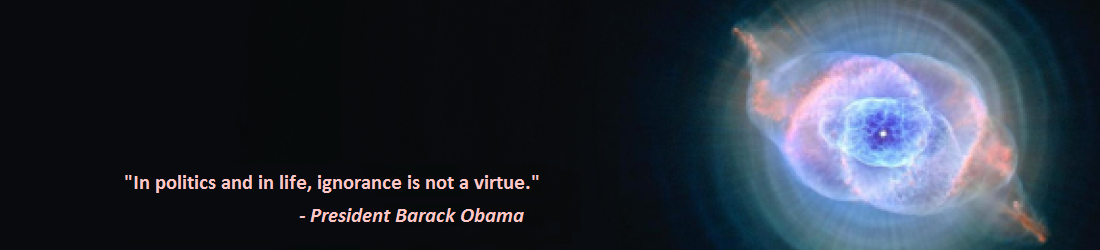
HV 2112

The July/August 2016 issue of Discover Magazine has an apparently paper-only issue on astromical Thorne–Żytkow objects (TZOs), of which I’d never heard. From Wikipedia:

A Thorne–Żytkow object is formed when a neutron star collides with a star, typically a red giant or supergiant. The colliding objects can simply be wandering stars. This is only likely to occur in extremely crowded globular clusters. Alternatively, the neutron star could form in abinary system after one of the two stars went supernova. Because no supernova is perfectly symmetric, and because the binding energy of the binary changes with the mass lost in the supernova, the neutron star will be left with some velocity relative to its original orbit. This kick may cause its new orbit to intersect with its companion, or, if its companion is a main-sequence star, it may be engulfed when its companion evolves into a red giant.

I boggle at the thought. And now some in the astronomy community believe the star known as HV 2112 may be the first known example of these objects. SciNews covered the initial announcement more than two years ago here.

When they took a close look at the subtle lines in the spectrum of HV 2112, they found that it contained excess rubidium, lithium and molybdenum.

Past research has shown that normal stellar processes can create each of these elements. But high abundances of all three of these at the temperatures typical of red supergiants is a unique signature of TZOs.

“I am extremely happy that observational confirmation of our theoretical prediction has started to emerge,” said Dr Zytkow from the University of Cambridge, who is a co-author of the paper accepted for publication in the Monthly Notices of the Royal Astronomical Society Letters (arXiv.org version).

Look at your smartphone. Odds are that some of its components were first created within a TZO.

Which Way are We Sliding?

Is it a world-wide movement towards autocratic rule? Here in the United States we’ve seen the candidacy of Donald Trump supported (currently) by an impressive (or frightening), as documented by a CNN Poll as being 42% (+/- 3.5%). Vladimir Putin continues has dominated a nominally democratic Russia for nearly 20 years. In Turkey, President Erdogan is cracking down on dissidents after an attempted military coup, although some question whether Erdogan is strengthening or weakening his position.

And in Israel, a historically strong democracy, question marks are starting to pop up regarding the behavior of Prime Minister Netanyahu. Ben Caspit reports for AL Monitor:

In the last seven years, Netanyahu has inched closer to autocratic rule than any other Israeli leader. He fortified his rulership and has consolidated several key government ministries under his wing. In addition to the premiership, Netanyahu also serves as foreign minister, communications minister, economy minister and regional development minister, in addition to other functions. Though the Communications Ministry is seen as an underfunded and small ministry, Netanyahu has no intentions of ever relinquishing it. …

Culture Minister Miri Regev did not hide the Likud’s aspiration to control the corporation. “It’s inconceivable that we’ll establish a corporation that we won’t control. What’s the point?” she asked. “We put down the money and theybroadcast whatever they want?” Minister of Internal Security Gilad Erdan, who initiated the establishment of the corporation about two years ago, tried to give Regev a lesson in democracy. But he seemed to be talking to a wall. Additional ministers attacked the establishment of the corporation and argued that there were not enough Likud supporters among the journalists in the corporation’s ranks. Others claimed that Naftali Bennett, the head of Orthodox Zionist HaBayit HaYehudi, has control over some of the journalists since they are “skullcap wearers” (Orthodox Jews). At this stage, Justice Minister Ayelet Shaked, a member of Bennett’s party, lost her cool. She banged on the table and blasted the Likud ministers, saying, “Stop it already with your lies! Learn to control [yourselves] and stop complaining. … You have your own newspaper, what are you whining about?”

The weakening of the free, neutral, independent press is worrisome; the reported behavior of the Likud ministers is horrifying. But it’s also edifying in that it recalls that one of the tools in discovering the activities of the forces of, well, let’s say the power-mad, those who adhere to rigid, tangible orthodoxies rather than the processes of democracy, have become aware that the light shined upon their activities by a free press are a discouragement to their activities and objectives. Their attacks on the free press are a signal event in the degradation of the body politic, and should be viewed with concern, and responded to forcefully, by those who believe that it’s better to have a democracy than a power-made dictator, no matter how scary the rest of the world appears.

After all, we didn’t need Donald Trump to defeat the Nazis; we were just fine with FDR and the Congress, Churchill and Parliament, and all the rest of our allies. Yes, the USSR was run by Stalin – but, alone, they would have failed.

Atlanta Botanical Gardens, Ctd

ABG: Permanent sculptures. First, this adorable puppy.

CAM00456

CAM00457

And then, the lizard herd:

CAM00463

Which, for reasons that escape me (oh, I’m tired, the visuals are odd, oh so odd), reminds me of a very charming T-Rex built of scrap metal in Faith, SD. RoadSide America provides a bit of information and this lovely picture:

Scrap iron Sue.

The artist is John Lopez, who I linked to yesterday.

Art for the Day

A sort of ultimate found object sculptor, John Lopez has done some interesting work with scrap metal when not doing his day job – which is

For the past ten years, John has been working on The City of Presidents project in Rapid City, SD. John Adams, John F. Kennedy and John, Jr., Calvin Coolidge, Teddy Roosevelt and Ulysses S. Grant are a few of the presidents John has placed on the street corners so far.

And here’s a sample of his off-hours work.

Lopez Sculpture.jpg

More here.

Video of the Day

Amazing stuff, dragging a wreck off the seabed.

And for all that I know it’s impractical, and even a negative in many cases, I’d still like to see humanity clean up its messes just like this: pick the whole thing up, salvage what can be salvaged, and make the sea clean again. There’s a few ships, such as World War II oilers and munition ships, that really need to be neutralized and removed.

For Want of a Few Holes

Who would think that drilling a few holes could stop an earthquake? Kate Ravilious writes about the ambitions of physicist Sébastien Guenneau in NewScientist (23 July 2016, paywall):

But in 2001, French seismologist Philippe Guéguen realised that getting buildings to sway could have unexpected benefits. He was studying the effect on Mexico City of a magnitude 7.4 quake that hit it in September 1995. While various parts of the city should have responded in the same way, some neighbourhoods shook for nearly twice as long as others. Softer sediments wobble more than solid rock, but underlying geology wasn’t enough to account for the discrepancy. Instead, it turned out that tall buildings were creating secondary waves in the ground around them, prolonging the shaking but muting the original surface waves. This suggested that the swaying high-rise towers were redistributing the earthquake energy, and providing some protection.

The idea that the waves themselves could be modified, rather than simply withstood, turned earthquake engineering on its head, says Guéguen, who is based at the Institute of Earth Sciences in Grenoble. The key is controlling the way in which the ground responds to incoming waves.

Guenneau had a surprising idea for how this could be achieved. While simply drilling holes in the soil may not seem like it would have much of an impact, he knew that the principle on which it was based had already achieved the impossible.

A small-scale test nearly worked to perfection, with only the small problem that rather redirecting the energy in another direction, or harmlessly dissipating it, the energy was reflected. They are now working on an improvement.

I have a couple of thoughts.

  1. Rather than redirect or dissipate, how about capturing that energy?
  2. On a deeper level, how does this disturb the overall system? Is it predictable, or are we setting ourselves up for something bigger? I can’t imagine what, but I do worry about ad hoc fixes that result in bigger problems down the road. Chalk that up to a few disasters of my own in which a fix for one problem lead to larger, unexpected problems somewhere else. I’m not saying a computer program is the same as a natural system … just something to think about.

In a sidebar, another scientist is investigating a similar system for mitigating tsunamis, inspired by the 2004 disaster.


Mysteries in the Sky

Spaceweather.com reports on the misnamed proton arcs:

Aurora photographers see these structures from time to time–tight ribbons of light, sometimes red, sometimes green, writhing across the night sky.  They are commonly called “proton arcs.”

Yet aurora scientists say they probably have nothing to do with protons.

“My opinion, and I believe the consensus of most aurora scientists, is that these arcs are not proton related, ” says Jason Ahrns, a researcher at the University of Alaska Fairbanks, “but I don’t know what does cause them.”

From Spaceweather.com’s gallery:

Taken by Sherri Grant on August 17, 2015 @ Just north east of Val Marie, Saskatchewan, Canada

Belated Movie Reviews

Having just finished viewing The Day Mars Invaded Earth (1963, aka Spaceraid 63), it’s difficult to find much to praise in connection with this movie, beyond the clear cinematography and excellent audio. A movie about a NASA scientist in charge of the Mars probe, he returns home to his angry wife and their children, only to find various members starting to become terrorized by what it appears to be other members of the family.

It’s true, the 30 seconds of the Mars-roving robot is  inutterably adorable, and the daughter has a certain charming freshness about her. But I could not help but wonder if under the wife’s ornate hair style there might lurk a motorcycle helmet; the little boy could have been used to greater affect; and despite the use of a noir ending, the entire plot sadly crosses the line from tantalizing to insipid. I’m not sure why: we are not overly informed as to what’s happening, the special effects are adequate. It may be the characters, who do not exceed the limitations we automatically place on them. The wife is angry, then terrified, with no particular innovation in her responses; the husband understands her anger, is preoccupied with his data, but has heroically chosen to work on his marriage rather than the data; the daughter is dutiful with both parents and with her boyfriend (lucky guy), who in turn gets so little camera-time that when he is offed, we feel nothing. Even the assistant scientist, despite the devotion of a freakish pair of glasses, has little impact in his bizarre ending.

Perhaps the problem lies in its theme: I couldn’t identify one, really. Don’t explore? Don’t send cute probes? Nothing really stands out. The morality of the theme Don’t go to Mars! has little impact or relevance on the typical movie-goer.

Don’t bother with this one.

Oh, yeah, the family estate is immense. Makes you wonder if it was actually one of the homes of William Randolph Hearst.

The Stream of Propaganda

Dipping into the old fishin’ stream, I hooked a bit of mail that, in part, starts out thisaways:

Charles Krauthammer is a brilliant man. Really. A man of character who lives life in a wheelchair. Among his other careers, he is a doctor of psychiatry. He was a devoted Democratic activist and presidential advisor. An independent thinker who won the Pulitzer Prize. He has both liberal and conservative stances and writes a weekly column in the National Review which is syndicated to 400 newspapers. He has been a regular panelist on a variety of programs, including Fox News. Mr Krauthammer is an independent thinker and has become a neoconservative. Why am I telling you this?, Because a brilliant man of character as he is can clearly see much that we do not.

Please read this article.

Recently, Charles Krauthammer alluded that he had no doubt some of the 30k emails Hillary deleted from her private e-mail server very likely had references to the Clinton Foundation, which would be illegal and a conflict of interest.

The first fatal weakness shows up here – “… he had no doubt …“. Why? Well, the article doesn’t say. Apparently he’s got the ol’ second sight.

The second weakness is that the introduction of this brilliant man is in itself a fallacy, the appeal to authority that has been discredited by skeptics. It’s going through your mind, right? A doctor of psychiatry and so many other careers, despite his physical disability, he must be so strong; he holds positions on both ends of the political spectrum, why, he must be fair-minded. Sorry, none of this makes any real sense, once you start thinking about it.

Finally, the factual parts are no doubt correct, and in fact I’ve heard Mr. Krauthammer described as a neoconservative many times. The writer depends on the ignorance of the reader to skip that little bit – but if you’ve been paying attention, it’s the neoconservatives who cried out for the war in Afghanistan, and then for the invasion of Iraq – indeed, it is their signature pair of achievements. But a large percentage of Americans do not approve of these wars, in retrospect.

Trend: Perceptions That U.S. Made a Mistake in Sending Troops to Iraq and Afghanistan

Afghanistan, as ever, has proven to be a hellhole, while Iraq’s war was founded on fraudulent assertions. Both have resulted in immense civilians casualties, and to proclaim they have achieved their objectives is specious in the face of the number of casualties, disruptions, and unintended consequences (Islamic State, etc) that were a direct result of them.

I’ve never heard of a neocon admitting the error. Indeed, many of them call for bombing Iran, resulting, without a doubt, in many more thousands of innocent deaths, not to mention the comparatively fewer American deaths.

So I just threw this fish back into the flood, as it appeared to be black and moldy, snarling with the sharpest of teeth, just like a lamprey.

Sea lamprey mouth

(Sea lamprey mouth (Photo: T. Lawrence, GLFC))

The sea-going neocon lamprey.

Atlanta Botanical Gardens, Ctd

Finally looking more closely at the first picture in this post, I’d like to say I think the fountain’s water is actually more interesting than the Chihuly glass itself. It might have to do with the contrast of the static attribute of the glass to the dynamic appearance of the water.

Just sayin’.

Solid

Hal Hodson reports on a fledgling movement to take back the Internet from the big sites in NewScientist (23 July 2016, paywall):

AT THE heart of the internet are monsters with voracious appetites. In bunkers and warehouses around the world, vast arrays of computers run the show, serving up the web – and gorging on our data. …

“Very big and powerful companies own a huge chunk of what happens on the web,” says Andrei Sambra, a developer with the World Wide Web (W3) Consortium at the Massachusetts Institute of Technology, the main standards organisation for the web. But we – the ones producing this valuable data – have lost control.

So what’s to be done?

Sambra is working on a project called Solid, which is led by none other than [Tim] Berners-Lee [inventor of the Web] himself. The idea behind this prototype software is to separate our data from the apps and servers that process it. With Solid, you get to decide where your data lives – on your phone, a server at work, or with a cloud provider, as it probably does now. You can even nominate friends to look after it. “We want to put the data in a place where the user controls it,” says Sambra.

Here’s an academic introduction to Solid by Berners-Lee and his team:

Each user stores their data in a Web-accessible personal online datastore (or pod). Each user can have one or more pods from different pod providers, and can easily switch between providers. Applications access data in users’ pods using well defined protocols, and a decentralized authentication and access control mechanism guarantees the privacy of the data. In this decentralized architecture, applications can operate on users’ data wherever it is stored. Users control access to their data, and have the option to switch between applications at any time. We will demonstrate the utility of Solid and how it is experienced from the point of view of end users and application developers. …

Each application (or set of applications based on one social network platform) controls its own data and often has its own authentication and access control mechanisms. As a result, users cannot easily switch between similar applications that could allow reuse of their data, or switch from one data storage service to a different one.

I think that last outtake strikingly summarizes the goal – if, say, there was a Facebook-2 out there, a competitor to Facebook, how hard would it be to switch over to it? Today, difficult – all the information that you value on Facebook, such as “friend” information, groups, etc, is owned by Facebook – Facebook-2 has no access to it. Imagine, if you will, that the information was not owned by Facebook, but was owned by you. This implies that both Facebook’s would have to know how to access your information – and you have given access permission to them – or not. Now the competition is sharpened.

There’s a lot of questions that will be inevitably asked of Solid, assuming it makes progress, both technical and social, and perhaps I’ll pursue them in future posts after digesting the previously linked paper, as it may have  answers to many that cross my mind. Instead, I’d rather return to Hodson’s article. This bothers me:

Andy Clarke, a philosopher studying artificial intelligence at the University of Edinburgh, UK, says that our loss of control goes even deeper. “When we use the internet in the ways it’s mostly available – through big nodes like Google and Facebook – we are giving ourselves away,” says Clarke. They are making big bucks out of us, and we don’t get a penny. Aral Balkan, founder of Swedish tech democratisation movement Ind.ie, calls such companies “people farmers”. If you’re not paying, you’re the product.

First, tThis strikes me as sloppy thinking. First, the use of the currency metaphor constricts the intellectual discourse to mere money. Rather, let’s ask this: does the work of these “big nodes” benefit us in any way? And the answer may be YES, in that we may be served marketing material for products we actually desire, to come up with just a single example; I suspect there are many more.

Second, all value is subjective: this is standard. All that trivial information associated to you has very little value to you; even as single bits, Google doesn’t care. But aggregated, then it begins to matter. By collecting it (a non-trivial activity) and analyzing it (also non-trivial) they are creating value from the detritus of us. This phrase, “They are making big bucks out of us, and we don’t get a penny”, is little more than rabble-rousing, and it’s unfortunate that it’s present in this interesting paper on disconnecting data from programs1.

I’d recommend taking a look at that paper (I may need a rainy afternoon, and it’s sunny right now) to see a possible future for the web – whether you’re a technical person or just a web user. It echoes, in my mind, the problems faced by the labor force with respect to unions in that sometimes workers don’t like the activities their unions take, and yet they find they often must belong. One solution has been Right To Work laws, which permit workers to opt out of the unions that represent them, but they are imperfect solutions. And perhaps this analogy is imperfect, but it does stick in my mind.


1I dislike this trendy word “apps”.

Atlanta Botanical Gardens, Ctd

ABG was hosting a traveling exhibition of Chihuly Glass. It was quite a lot of glass, which I mostly avoided taking pictures of it, but here’s what we did take. First, my favorite:CAM00455

And here’s a sequence on another installation:

CAM00460CAM00459CAM00458

A special gift shop was full of his material, from books to actual artifacts. I’ve been through his site looking for our favorite, but was not successful. It was $7600, so we don’t feel too bad at not snapping it right up.

Atlanta Botanical Gardens

On our vacation we visited the Atlanta Botanical Gardens (ABG). Omitting mention of our actual travel to ABG and back to the hotel, we had a very good time and would happily recommend it to Atlanta-traveling gardeners. ABG has a number of different areas, from tropics to high altitudes to plants native to the Atlanta area. We’ll start with carnivorous pitcher plants:

CAM00469

As we can see, their pitchers are filled with a fluid which traps and digests the unfortunate insects which slip on the edge of the pitcher. Yes, we did wonder if they had to be specially fed by ABG staff, or if Atlanta insect life was sufficient to the job, but we did not find out. These were found, IIRC, in the tropics part of the displays. In the same area we found this charming orchid:

CAM00470

Three blooms on one orchid, but I fear the photo is a trifle blurry. This was also found in the tropics, I believe:

CAM00468

Charming, but we do not recall the name.

What to do about Flint, MI, Ctd

Just an update on the next step in the Flint, MI crisis, from The Detroit News:

Criminal charges leveled Friday against six current and former state employees center around allegations they altered or concealed alarming reports showing high levels of toxic lead in Flint’s water and the bloodstreams of the city’s children.

Attorney General Bill Schuette’s prosecutors contend much of the cover-up occurred on or around the same day in late July last year.

At the Department of Health and Human Services, prosecutors allege employees Nancy Peeler and Robert Scott “buried” an epidemiologist’s July 28, 2015, report showing a significant year-over-year spike in blood lead levels in Flint children.

Corrine Miller, the state’s top epidemiologist, later ordered a DHHS employee to delete emails about that July 28 report and prevented action to alert top state health officials and the public, Schuette said.

A Genesee County judge on Friday authorized charges against Miller, Peeler and Scott for misconduct in office, conspiring to commit misconduct in office and willful neglect of duty related to allegedly concealing or disregarding the test results.

Special Prosecutor Todd Flood’s investigation also found that on same date, three municipal water regulators at the Department of Environmental Quality altered a water-testing report to exclude some samples to keep overall lead levels under the federal limit.

Schuette filed charges against DEQ water quality analyst Adam Rosenthal on Friday for allegedly altering the report in coordination with water regulators Stephen Busch and Michael Prysby, who were charged with similar misconduct crimes in April as part of the attorney general’s wide-ranging investigation.

It occurs to me to wonder: it’s not unheard of to subject potential employees to various tests, such as polygraphs (dubious as they may be), as a condition of employment; and folks seeking admission to the Bar in Minnesota are required to pass an ethics test. I wonder if people working public safety jobs, such as these people, are given ethics tests, and if not, why not? This appears to be a failing of ethics, and since a failure in that area could result in severe injury or death, it would seem appropriate to test for the specialized ethics knowledge peculiar to their work.

I will be morbidly interested in hearing the motivations of these individuals, if found guilty, particularly of Miller, the head epidemiologist. The actions described sound deliberate, and if guilt is found, I’d hope for severe sanctions.

(h/t Steve Benen)

Current Movie Reviews

Love & Friendship (2016) is based on Jane Austen’s novel Lady Susan, and, for those unacquainted with this literary genre practically invented by Mz Austen, this is a very droll movie, indeed, so dry that one feels the sands of the desert slowly sifting through one’s mouth as Lady Susan Vernon (Kate Beckinsale), a widow, gradually wreaks carnage throughout her late husband’s family. Having a convenient intimate in Alicia Johnson (Chloë Sevigny), we get a view of both sides of the coin, as she plays the men for fools and then details her results and further plans to Alicia in what might be best described as a high sociopathic manner. The traditional mores of society have vanished completely from the metaphorical plateau, and we are delivered tart observations on the foolishness of men, and the dangers of other women.

The plot is trivial, the characters are all. Beckinsale is impeccable as Lady Susan, while Chloë Sevigny is more than adequate as her confidant. The other ladies are more or less competent in their parts. The other gender – for the most part, their foolishness makes me hesitate to actually place them in the category of men – is also more than adequately represented by their portrayers.

Alas, the pacing of the movie is flawed. For most of the movie, Lady Susan flirts here and there, nearly marries and then breaks the engagement. And then, her erstwhile swain is abruptly married to Lady Susan’s daughter, and then a note is delivered reporting the marriage of Lady Susan herself to the movie’s buffoon. There is no real build to a climax, and perhaps a comedy of manners doesn’t really need such a thing, for the goal seems to be to amuse the audience with a character who can illuminate some of the absurd manners which, oddly enough, serve to oil the machinery of humanity which works none-to-well (with thanks to Heinlein). Still, it instills in the tale a curious flat quality, a sense of no change in the rhythms of the lives of the characters. Characters change, yet life continues apace. Perhaps this is a goal of Mz Austen.

As a final note, at least for American audiences, one must be on the ball and paying close attention. Unlike most contemporary movies in which dialog and images are embossed into the brain much like a design is embossed into a leather gauntlet, Love & Friendship merely presents the dialog, with no cue as to what the importance of this line of dialog might be, or into what genre, if you will, it falls. One must garner from content only whether this is merely operational chatter, or if one character or another is committing a gross violation of the rules of polite society for the benefit of the humors of the audience. Do not plan to play with your smartphone during this flick, for it will serve you poorly.

Ingersoll, Ctd

Ingersoll & Jacoby (the biographer) on secularism, contrasted to Social Darwinism:

A secularist society would mean

“… living for ourselves and each other; for the present instead of the past, for this world rather than another … It is striving to do away with violence and vice, with ignorance, poverty and disease … It does not believe in praying and receiving, but in earning and deserving.”

A man who professed this humanistic secular creed could have hardly agreed with [Herbert] Spencer, who frequently said of the poor …

“If they are sufficiently complete to live, they do live, and it is well that they should live. If they are not sufficiently complete to live, they die, and it is best that they should die.”

In a short biography such as The Great Agnostic (effectively 190 pages, plus an Afterword, which I read, and Appendices, which I skipped) there’s scarcely room to properly treat all of the opinions of the man, and so there’s a lack of logical progression concerning the definition (or results) of a secular society that I would have preferred to have seen; if one plans to rip away the comforting religion to which humanity clings, at least something which can be logically studied should be presented1. So what we have here is a conclusion, not a closely argued discussion: this is how he sees a secular future. Naturally, given that he was a creature of the 19th century, he did not see what are arguably the secular disasters of the 20th century: communism and its Gulag Archipelago. It might also be argued, however, that these were the natural and logical conclusions of a society previously arbitrarily ruled by the Russian supreme rulers, and since such societies typically have some large facet of force to hold them together, in the face of its disappearance, the traditional social norms outside of force are weak and ineffectual. A peaceful society has not had a chance to evolve, and with the exponential development of technology, a combination of immense military power and unrestrained ambition and paranoia came into being, with predictable consequences.

Herbert Spencer was a British philosopher of the day, a friend to Ingersoll, and

During his lifetime he achieved tremendous authority, mainly in English-speaking academia. “The only other English philosopher to have achieved anything like such widespread popularity was Bertrand Russell, and that was in the 20th century.” Spencer was “the single most famous European intellectual in the closing decades of the nineteenth century”[3][4] but his influence declined sharply after 1900: “Who now reads Spencer?” asked Talcott Parsons in 1937.

Spencer is best known for the expression “survival of the fittest”, which he coined in Principles of Biology (1864), after reading Charles Darwin’s On the Origin of Species. This term strongly suggests natural selection …

The quote of Spencer regarding the poor clearly ignores context: would the Royal Family of Britain be subject to such conditions? Of course not. I read it as merely giving cover to the discouraging observation that, with the limitations of the era, the poor could not easily be resolved.

He also seems to have suffered from the intellectual blind spot that anything natural is good, tangible or not. As we all know, arsenic is merely one product of nature inimical to ourselves; it’s worthwhile to ask about any other assumption, and I believe we may come to the conclusion that Social Darwinism does not pass muster, simply based on the obvious fact that it is contradictory to the basic impulse motivating society: we take care of each other. We provide for the common defense, the sick, the elderly, all those who have, or can, contribute to society. We understand that we’re greater together than apart. To use an unfortunate phrase, this is the social contract implicit in society.

This is important because if that contract is broken – if we euthanize the elderly, we walk away from the sick, we fail to care for the unfortunate – then those who have a choice, and something valuable to contribute, may walk away, endangering society by weakening it. A society which has a weak social contract may not attract those who can most contribute to it, and this is a world of competitive societies.


1In fact, following Ingersoll’s death a Collected Works was assembled by his family and published, and while I do see them online here, I’ll also keep an eye out at estate sales – the Internet necessarily being a secondary source.

DNC Fourth Night

I just finished listening to Chelsea and Hillary’s speeches, and didn’t think them all that noteworthy. However, one thought finally did smack me right in the forehead:

This is the very first Presidential contest in my memory in which the central point of contention isn’t issues, but instead qualifications. I cannot remember, going back to Nixon, any such contest where the fight isn’t going to be so much over positions as whether the Donald Trump possesses the qualities for the office of President1. Does he have the temperament, the stability to be handed the codes? Does he have the experience to run one of the largest government bureaucracies in the world?

What will he do when the leader of North Korea taunts him?

This will be fundamentally different in that rather than evaluating issues, we’ll be evaluating the candidate as the primary criterion – whether he’s too volatile, too hands off, too interested in himself – or not. And this will certainly make it a different election than those to which we’ve become accustomed.

[This post has been updated with the proper title.]


1I vaguely recall some muttering about Reagan being too old for the position, but I don’t recall it being a pivotal part of those campaigns – particularly given his riposte concerning the youth of his opponent in the second campaign.

Trump, Secret Agent?

Ever wonder if Donald Trump qualifies as an agent of Russia, secret or overt? Susan Hennessey and Benjamin Wittes of Lawfare are on the case:

Question #1: Is Donald Trump an Agent of a Foreign Power Targetable Under FISA?

Answer: Not On the Current Record.

One way of asking whether a U.S. person is a Manchurian Candidate is to look at whether he meets the criteria for surveillance under the Foreign Intelligence Surveillance Act (FISA). The fact that we are even writing this sentence about a presidential candidate is a reflection of what a strange year 2016 is.

FISA defines an “agent of a foreign power,” in relevant part, as follows: any person who “knowingly engages in clandestine intelligence gathering activities for or on behalf of a foreign power, which activities involve or may involve a violation of the criminal statutes of the United States”; or who “pursuant to the direction of an intelligence service or network of a foreign power, knowingly engages in any other clandestine intelligence activities for or on behalf of such foreign power, which activities involve or are about to involve a violation of the criminal statutes of the United States.”

The DNC hack provides considerable evidence that Trump is the beneficiary of the clandestine activity of “a foreign power.” And there is plenty of evidence that Trump has spoken in a fashion that would reasonably please the foreign actor in question. But there is no evidence at all that Trump has engaged in or abetted clandestine espionage activity himself, much less that he has done so in probable violation of any U.S. law.

So if the Manchurian Candidate question is one of whether Trump is a Putin agent within the meaning of FISA, the public record certainly does not support that.

But there’s more!

Political Comparisons

The political punditry has certainly had reason to buzz over the Trump candidacy, but lately it’s been expressing a new emotion: fear. Andrew Sullivan appears to be nearly breaking down during his live-blogging, Steve Benen has certainly expressed deep concern, and now Steve reports Ezra Klein, too, is deeply worried:

Vox’s Ezra Klein wrote a compelling piece last week on the degree to which Trump has left him, on a very personal level, feeling scared. The night of the Republican’s convention speech, Ezra said he felt “genuinely” afraid for “the first time since I began covering American politics.”

Ezra added yesterday, after Trump’s bizarre press conference in which he called for Russian intervention in the U.S. election, “It’s weird to keep saying this, but this is not okay. This is not a man with the temperament, the steadiness, the discipline to be president. The issue here isn’t left versus right, or liberal versus conservative, or Democrat versus Republican. It’s crazy versus not crazy.”

After watching Obama’s endorsement speech last night, Trump is in the unfortunate position of being implicitly compared to a man who stepped into a very difficult position and really hit the ball out of the ballpark. Never a panicked move, hardly any mistakes, zero scandals, just a Congressional GOP that forgot how to compromise. This is not to excuse Trump, of course, but merely to point out the stark contrast between the current occupant, well trained in the government sector, and a businessman whose very competency may not be all we’d like to think.

RNC Second Night, Ctd

Responses to the RNC second night coverage:

Even the formerly disgraced won’t associate themselves with Trump. Speaks volumes.

Another responds to the first:

… there is going to be a lot of butt sniffing when he is elected. Politicians don’t forget.

Carrying a grudge? Perhaps on the Republican side – but on the Democratic side I see that the winners don’t ride roughshod over the losers, as Obama hired Hillary 8 years ago, and has now enthusiastically endorsed her and plans to campaign for her.

On the other side, Trump is reportedly considering starting a super PAC – for taking vengeance on his vanquished foes. That’s yet another new political behavior.

Vacation

We’re home from a vacation trip (Atlanta, Traverse City (MI)) and getting our lives put back together here; back to work on Monday.

We’ll post any pictures we think are worthy.

DNC Third Night

Tim Kaine came out and introduced himself, and then proceeded to attack Trump fairly effectively, although I must admit he seems to be just a bit of a doofus. This is not a bad thing, it’s just an apparent characteristic which is probably misleading.

Now, after a lovely introduction by a “gold star mother” (lost a son in Afghanistan) and a video aimed to give viewers an insight / reminder of how many crises Obama has faced, the President emerges and shows why he may be the leading orator of the age. After humor designed to connect to the audience, he affirms his faith in the Nation, covers his successes – which his opponents may deny, but are often confirmable with a bit of research – and is now connecting Hillary to his history.

His sense of pacing and the audience, his clear voice and control of his tone, and the content (does he write his own?), allows listeners to connect to him and his policies. As he argues for Hillary, as he bears witness to Hillary’s achievements and experience, he makes her believable, because he’s been there.

Now a shout-out to Kaine, affirming Hillary’s choice.

As Obama beats on Trump, for which there is so much evidence, his calm confidence at the microphone is as amazing as it is with Bill. He reminds us that since the election of 2000, the Republicans have been made up of third-raters – and the Democrats have managed to rise above them in terms of competence. Not necessarily in guerilla marketing, it’s true – but in bringing an understanding of American laws and traditions to the serious task of governance.

This is a speech to rally the Democrats, to remind them that they have to vote to win – a problem for Democrats, for reasons I don’t really fathom. Independents should find it reassuring, especially as facts are cited, connected to the narrative of the President – but this is connecting Democrat’s principles to positive results. He reminds the crowd that democracy is not a one day thing, but an everyday thing – he defines democracy, how hard it is, and how everyone must work at it in order for it work for us – rather than for just a few.

So, I wonder … what will Obama do next January? In a few years will he be looking at returning to the Senate? He’d be joining a very small club (Johnson and JQ Adams). But he can contribute without occupying an elective office.

And what, in 50 years, will historians say about him? I can’t wait to find out.

Later: and out pops Hillary for a thank you hug. Nice touch. Trump dead-enders must be furious – Trump is so outclassed as to look like a fumbler.