Comedian of the Day

Being more or less disconnected from pop culture, I’m sure all my readers know of this guy, but since my sister just introduced me to one of his performances, I must say Trevor Noah is marvelous, with both great content and superb technique. In this video, pay attention to his command of accent, and how he imagines the voice of Barack Obama was constructed with the help of Nelson Mandela.

https://www.youtube.com/watch?v=0mV8OQVqfdg

North Korea Poking, Ctd

A reader remarked on missile launch systems before the more recent North Korean launch of 5 missiles:

Wild ass guess on liquid fuel rockets: easier to build, more control over thrust amount and direction might make them more accurate and/or easier to direct to location. Solid fuel is light it and forget it — basically a contained explosion until it all burns up. And often, they explode if not made just right — or even during the making.

Clarification on “easier to build”: liquid handling systems, pumps, plumbing, etc. all complicated to build, but are mostly “knowable” problems of managing liquids. If you use relatively stable things like hydrogen peroxide and kerosene, it’s even reasonably safe (liquid oxygen gets harder, hydrazine is probably entertaining). But solid fuel, while conceptually simply is a bugger to get right: stable mixtures which burn at just the right rate without going boom or burning through the shell (see Challenger). Mixing up that glop without it igniting is a challenge, too.

But I’m not a rocket scientist.

I do recall, during the breakup of the Soviet Union, talking to someone who stated that many Soviet Union missiles had gone stale, meaning that their liquid fuel launch systems had actually deteriorated. They consisted of two separate containers of material; launch consisted of mixing them and, I think, standing back. One of the materials had a very limited lifetime, apparently.

Obama Over The Pond Assessment, Ctd

A despicably long time ago, my reader had a rejoinder on the topic of Obama’s mistakes impacting Clinton’s failure:

I mostly agree with you on Obama trying to avoid a greater divide by not prosecuting the misdeeds done by the Bush administration. And maybe that’s the calculus that put him firmly on the side of the banksters. But that specific subject did not have to come up during the campaign for it to be a deciding factor. People felt screwed by the establishment in 2008 and 2009, and remembered that FEELING well in 2016, even if they could not connect the dots to the bank bailout. Trump played into that feeling, and here we are.

Clinton very well described her policies, and on a policy basis, most voters, even most Trump voters, actually agreed with her. But they were not “hearing” policy talk from Clinton. Al they were “hearing” was she was part of the establishment that screwed them the past 8 years. It almost did not matter what she said, because the disaffected voters were not ready to hear it. (I think she could have gone radical, but even then they may not have listened.)

I apologize for forgetting about this reply. I have a couple of thoughts on this matter:

  1. The voters had an opportunity to vent their anger in 2012, but … well, at least didn’t enough to toss Obama out of office. There’s certainly many factors in play here – Romney’s Mormonism played against him in a party dominated by evangelicals, as would his government experience (yep, you read this right), as his tenure as Governor of Massachusetts would mark him as part of the establishment – that particular inclination working against Clinton four years later. Not to mention his remark about so many voters latched on to the government teat – that would chase away most potential liberal votes. But Obama did win, and left office four years later on a high note.
  2. Clinton, for all her being of the establishment, is not (and I suppose was not is more accurate, as I doubt we’ll see her in a political role ever again) much of a politician. Trump was a far more polished politician than Clinton, although in a mold to which we’re unaccustomed – which is to say, promise everything to the disaffected, discredit the traditional, independent sources of dependable facts when they go against you, and always lie when the lie benefits you, even if you’re caught in it. I despise that particular model. But Clinton’s Deplorables remark was disastrous, no matter how prescient it’s proving to be; her hyper-intellectual approach didn’t play well in a country in which many people put their religious convictions ahead of, even in place of, their intellectual attainments. Starting from a position of dominance twice (2008, 2016), she failed twice. In a way, she campaigned as if she lived in the country she wants to live in, where rationality and intellect are dominant. That’s not what we have, even though she won the popular vote – we have a dismayingly large number of folks who are gullible, who are desperate, and who either did not do the research on the candidates, or didn’t mind having a liar for a President.

Clashing Waves

I see on USAA that they believe digital wallets are the wave of the future, and provide a primer:

The digital wallet in your smartphone may soon replace credit and debit cards as the benefits and simplicity of paying with your phone make reaching for plastic or cash inconvenient.

A digital wallet — often called a mobile wallet — is accessed through an app on your smartphone or other mobile device and enables you to digitally store and access items typically found in a physical wallet.

Among their advantages:

By assigning virtual device account numbers to cards, mobile payments are secure and do not use actual debit or credit card numbers when making a purchase. Fingerprint or passcode authentication adds an extra security layer.

But will you have a smartphone? Andrew Sullivan wonders:

Since I wrote about digital addiction, I’ve been constantly and understandably asked what might be the antidote. Well, here’s one: the dumbphone. Nokia is now making the once-beloved 3310 model again — and the new ones look pretty cool. You can call and text but you’re not carrying around that addiction device called a tiny mobile computer. They’re a fraction of the cost of a smartphone — and have a variety of uses, as this great review in The Atlantic explains. You can use it in places where a smartphone might be easily damaged; or as a replacement for the home landline; as a way to stay in touch while staying sane. Sadly, the new ones aren’t yet available in the U.S. — but the demand, I suspect, could be huge. Think of them like the extraordinary revival of vinyl for music — a return to the actual pleasure of a simple activity, a reminder that change isn’t always for the better, that the past is always retrievable in the present. We don’t have to be trapped in our culture. We can choose to defy it. Increasingly, it seems to me, we must.

The Nokia offering will constitute experimental closure: will the utility offered by the smartphone outweigh the distraction that comes with it?

Belated Movie Reviews

I can’t wear lipstick even?

If you want a lovely bout of creepiness, Die! Die! My Darling! (aka Fanatic 1965) is not a bad choice. Legendary actor Tallulah Bankhead is Mrs. Trefoile, the matriarch, the strait-laced, devout, bitch queen of a vanishingly small family in the British countryside, mourning her dead son, Steven. With her are a nephew (I think) and his wife, Harry and Anna, who function as servants, along with feeble-minded Joseph (an under-utilized Donald Sutherland).

Into their midsts comes Patricia, who was Steven’s fiancee before his death a couple of years ago, paying her respects to the woman who would have been her mother-in-law. It only seems the right thing to do.

Unfortunately, to Mrs. Trefoile, a betrothal is as good as an actual marriage, and an actual marriage is, well, forever. So God tells her, at least. Soon questions as personal as Pat’s virginity come up, and when she’s caught wearing a red blouse, well, it’s clear that she needs to have the error of her ways corrected before she can leave.

This delves into some conventionally creepy territory as we watch Mrs. Trefoile trod the paths of religious madness in her peculiar ways. But rather than your usual movie religious fanatic, we also get to see her moments of self-doubt, and her moments of madness. Is her devotion to reading the Bible a defense against the waves of insanity breaking in her mind? Why does Steven’s sexual purity matter?

And Patricia is not the stereotypical female victim. Stabbed, starved, beaten, even shot, she lays plan after plan for escape, showing admirable spirit in the face of a madness unresponsive to any sort of reason.

But between the sexual urges of Harry and the inexorable demands of her own religious compulsion, soon the old lady is faced with a bitter climax from which even she cannot find solace with Steven, for Pat, truth or lie, has told her a bitter thing. And over the edge she goes.

Quietly well acted, and with only the slightest touch of the British brittleness that has annoyed me in other movies of this era, it’s hard to find fault, from the performances to the technical aspects to the story. In particular, we liked how well the story hung together, with only one very small plot hole – and even that can be easily reasoned away. However, the underuse of Donald Sutherland was disappointing.

While a movie of this sort is not to everyone’s taste, if you like a good creepy movie, then this is Recommended.

And if you like a touch of irony in your movie, consider this: our religious fanatic is played by one of the most notorious libertines of Hollywood. Reputed to throw wild parties in which she’d show up completely nude, Bankhead’s credited with the quote, “I’ve tried several varieties of sex, all of which I hate. The conventional position makes me claustrophobic; the others give me a stiff neck and/or lockjaw.” I wonder if she giggled a lot while reading the script.

Act In Accorance With Your Institution

Andrew Sullivan’s latest missive on New York Magazine includes some coverage on the latest craze showing up on a few college campuses. I’d heard about it showing up at Cal State – Northridge when a group of Armenian students shutdown a lecture by a Turkish scholar, as reported here (and by many others) by the Cal State Northridge Sundial:

Scholar George Gawrych got through no more than five sentences during his presentation on his book about Turkish army officer Mustafa Kemal Atatürk before students raised their voices in protest Thursday at the Aronstam Library in Manzanita Hall.

Over 20 protesters stood up from their seats, turned their backs on Gawrych and repeatedly chanted “Turkey guilty of genocide” and “genocide denialist.”

Gawrych waited briefly as other attendees voiced their opinions to let him speak, until he began walking up and down the aisle trying to get the protestors to face him.

I wrote it off as an isolated incident by a group frustrated by either Turkish obstinance or bad history. But now it appears it was a precursor to a more general movement (I’m not sure how many incidents may be tied to it, so I have no estimate on size), as Andrew analyzes:

Here’s the latest in the assault on liberal democracy. It happened more than a week ago, but I cannot get it out of my consciousness. A group of conservative students at Middlebury College in Vermont invited the highly controversial author Charles Murray to speak on campus about his latest book, Coming Apart. His talk was shut down by organized chanting in its original venue, and disrupted when it was shifted to a nearby room and livestreamed. When Murray and his faculty interlocutor, Allison Stanger, then left to go to their car, they were surrounded by a mob, which tried to stop them leaving the campus. Someone in the melee grabbed Stanger by the hair and twisted her neck so badly she had to go to the emergency room (she is still suffering from a concussion). After they escaped, their dinner at a local restaurant was crashed by the same mob, and they had to go out of town to eat. …

“Intersectionality” is the latest academic craze sweeping the American academy. On the surface, it’s a recent neo-Marxist theory that argues that social oppression does not simply apply to single categories of identity — such as race, gender, sexual orientation, class, etc. — but to all of them in an interlocking system of hierarchy and power. At least, that’s my best attempt to define it briefly. But watching that video helps show how an otherwise challenging social theory can often operate in practice.

It is operating, in Orwell’s words, as a “smelly little orthodoxy,” and it manifests itself, it seems to me, almost as a religion. It posits a classic orthodoxy through which all of human experience is explained — and through which all speech must be filtered. Its version of original sin is the power of some identity groups over others. To overcome this sin, you need first to confess, i.e., “check your privilege,” and subsequently live your life and order your thoughts in a way that keeps this sin at bay. The sin goes so deep into your psyche, especially if you are white or male or straight, that a profound conversion is required.

Like the Puritanism once familiar in New England, intersectionality controls language and the very terms of discourse. It enforces manners. It has an idea of virtue — and is obsessed with upholding it. The saints are the most oppressed who nonetheless resist. The sinners are categorized in various ascending categories of demographic damnation, like something out of Dante. The only thing this religion lacks, of course, is salvation. Life is simply an interlocking drama of oppression and power and resistance, ending only in death. It’s Marx without the final total liberation.

And, as university students and professors (a few were part of the semi-lynching at Middlebury), they should have an allegiance to the free and open exchange of information which is at the very heart of Western higher education. Instead, they have indulged in intellectual and physical violence, attempting to inflict their views by force.

This is surely grounds for ejection from their institutions.

But, on a very fundamental level, this also allies them with the white supremacists. Not on the common level of violence – that’s too general.

No, I’m talking that other, dishonorable trait, which I talked about before.

Laziness.

In essence, these folks are attempting to inflict their view on the world, not through the hard work of research and logic and communications, but quickly, if uncleanly, through some simple violence. For them is not the way of hard work. They want this to be quick, without having to actually justify through reason anything they’re doing.

I can understand the frustration that views they oppose don’t simply disappear, but humanity is not a rational species – it’s merely capable of being rational. By engaging in irrational behaviors themselves, they succeed only in encouraging their critics and opponents to do the same. By abandoning their allegiance to truth and reason, they encourage their opponents to do likewise.

And that’s just not good for anyone. Just as the current GOP dash to the right is destroying the GOP – and possibly the world – this incident shows the left is fully capable of madness as well.

It Sounds Like A Cool Job, But It’s Not

At least it wouldn’t be if the press was more aggressive about doing its job. A recent remark from White House Press Secretary Sean Spicer has brought into sharp relief, at least for me, that the role of the President is not temporary King or truth master or even much of a decision maker. What did he say? From the MSNBC Twitter account:

Spicer quotes President Trump on jobs report: “They may have been phony in the past, but it’s very real now”

I.e., candidate Trump proclaimed that unemployment stood at 40% during the campaign, but now President Trump accepts that it’s 4.7% … with some jubilation, even.

Look, for all the noise out there, our society operates best on truth. Thus we have the judiciary, fact checkers, and multiple checks and balances, all there to expose the truth.

And so when Trump, as a candidate, claimed the unemployment rate was 40%, that was a scandal – and he should have been told to put up or shut up. And some tried, but he ignored them and was permitted to get away with it by his core group of supporters. The same goes for his violent crime statistics, his accusations against the FBI, and other such claims.

We keep our sources of facts and truth, if you will, separate from the politicians who stand to benefit, or suffer, from them, because politicians, just like the rest of us, are fallible folks who should not be tempted. Then we staff them with dedicated, non-partisan experts, because whoever is in charge – and the rest of us! – needs the best information possible.

When the truth is not held sacred, buildings fall down and your family members die ghastly deaths. Think not? Remember the Soviet Union, where ideology was more important than truth.
Source: Wikipedia

So how does this tie in with the role of the President? It defines the role for what it is not: a truth-giver. The person occupying that is not here to make up numbers and tell them to us. In fact, those numbers are independent of that role because we can, because we should, use those numbers to evaluate the President’s performance. When Rep Lamar Smith (R-TX) suggested that the citizens of the United States should get their information directly from President Trump, he displayed his complete ignorance of the structure of the government, not to mention the foibles of mankind, and he should be censured and removed from his position for such a failure.

In recognizing that removal from the President’s role (which, to be accurate, occurred in the time of Washington, et al), the recognition of the independence of these critical agencies, we also recognize that the role of the President in making Executive decisions is narrowly demarcated; the President can make some regulations, but Congress makes the law, and the Judiciary executes the law – or not, as it sees fit under its responsibilities. The President is constrained because of the potential power – and influence – the President can possess.

So when Spicer made that hideous remark, the press corps shouldn’t have chuckled, as reported. They should have given him the finger and walked out in a fury, announcing it to the world via their front pages. Because the behavior of President Trump is worthy of impeachment. As Americans, we should be hiring the best to be President, but here we’ve hired someone who’s working on being the worst.

And that’s simply not acceptable.

And for those of us interested, here’s one of those independent fact agencies which Trump denigrated when he was a candidate: The Bureau of Labor Statistics.

Yeah, you decide. No riots in the streets. Some quiet desperation in the some towns. Work to be done. Or did Trump’s magic wand fix everything.

Belated Movie Reviews, Ctd

A reader reacts to the review of The Killing:

Next up, Kubrick’s “Lolita.” As to the religious undercurrents in “The Killing,” well, it was a genre picture, and noir is ultimately a religious film genre. The bad guys always pay in noir. Kubrick himself was raised as a secular Jew, and when the subject of religion came up (mostly in regard to 2001’s “spirituality,”) he gave many different and somewhat conflicting answers. According to Stephen King, Kubrick hung up on him when King said he believed in God.

I do not see film noir as necessarily religious genre, as I’ve never restricted the concept of evil to the religious realm. I see noir as morality tales (itself a religious genre, but I’m busy ripping out these things by the roots, might as well get all of them), illustrative examples of how bad decisions can doom people – or bad circumstance (so it becomes a lesson to the powers-that-be to fix the circumstance). Incidentally, most of the noir I’ve seen doesn’t have any religious elements, and even in The Killing I had to stretch a little bit, although otherwise it was mere caprice that did the bad guy in.

Insofar as Lolita goes, I may be terminally ruined in that regard. Having seen it on stage, by The Four Humors, wherein the lead female role was played by a 6 ft, 280 lb guy with no makeup, not shaved in three days, and in a shirt a size too small …. well.

Source: City Pages

And thanks for the historical note on Kubrick.

Love The Analogy

Gotta say I like this idea. NewScientist (25 February 2017) reports on the idea of Paula Jofré of the University of Cambridge for tracking the evolution of stars over generations using ideas from biological evolution:

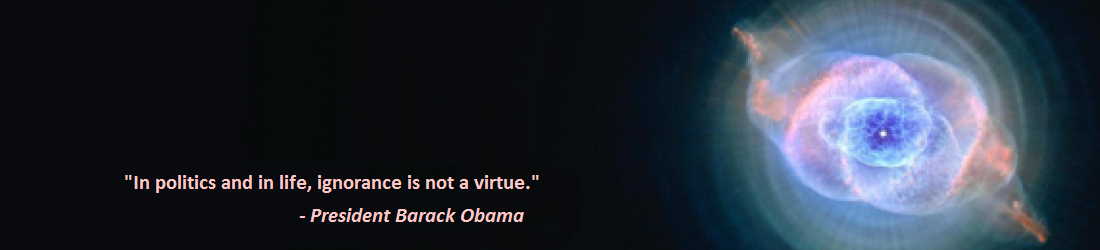
This post is just an excuse to put this gorgeous image on the blog.

Stars move around the galaxy’s spiral arms and disc, making it difficult to figure out where they came from. But if they were born in the same cluster, stars should have similar chemical signatures.

Astronomers use chemical tagging to try to identify stellar siblings even if they have drifted apart. But Jofré and her colleagues thought they could take this a step further by taking a page from evolutionary biology.

“This is an invitation for astronomers to think in a new way about the history of stars and interpret their past,” Jofré says. “A lot more information could be extracted.”

Combining traces of 17 chemical elements as stellar “DNA”, the team categorised 22 stars in our galactic neighbourhood.

Using this approach, the team assembled a tree with three branches associated with stars of different origins. They tentatively argue that the thicker part of the galaxy’s disk forms new stars more rapidly than elsewhere in the Milky Way, which is consistent with other research. They also found that some stars may have even originated from another galaxy that collided with the Milky Way long ago.

Of course, DNA is relatively stable during the lifetime of an organism, while stars actively consume & transform their constituents. However, I see in the academic paper arXiv:1611.02575 this statement:

In astrophysics the chemical pattern obtained from spectral analysis of FGK type stars [stars belonging in the classifications of F, G, or K] can be interpreted as stellar DNA , as it remains intact for the majority of their lives (Freeman & Bland-Hawthorn 2002). The mechanisms for change in chemical abundances can also be identified. There is enrichment of the ISM [interstellar medium], which is relatively well understood due to advances in nucleosynthesis and SNe yield calculations (McWilliam & Rauch 2004 ; Matteucci 2012 ; Kobayashi & Nakasato 2011). Differences in chemical abundances of stars can also be the result of environmental processes bringing gas and stars from extragalactic systems and dynamical processes. Dynamical processes are a result of perturbations from nearby non-axisymmetric features such as the bar, spiral arms, molecular clouds, or merger activity. This can lead to radial migration, which is a change in the angular momentum that conserves the orbit’s eccentricity or heating, which is a change in the eccentricity that conserves the angular momentum (Sellwood & Binney 2002 ; Minchev & Famaey 2010).

So being able to trace where a star was born vs where it’s located now could be quite interesting. Seems academic? Some theories of mass extinction events involve the solar system crossing the plane of our home galaxy, the Milky Way. Paul Gilster discussed it on Centauri Dreams back in 2007:

Muller and Rohde used a huge fossil database of marine organisms developed by the late John Sepkoski Jr. (University of Chicago), one whose data extend back to the time of the ‘Cambrian Explosion,’ the period when so many forms of multicellular life emerged. But while Muller and Rohde pondered alternative explanations for the cycle, two University of Kansas professors have come up with a theory involving the Sun’s position in the Milky Way, one that has gone on to win Muller’s approval.

The Solar System moves up and down as it orbits the galactic core (see image at left). Mikhail Medvedev and Adrian Melott, taking that motion into account, factor in the motion of the Milky Way itself, hypothesizing that its leading, north side generates a shock wave that exposes the Earth to high-energy radiation every 64 million years or so. Here’s Melott on the matter:

“I did notice that not only did these time scales appear to be almost the same, but the drops in biodiversity coincide with the times when the sun is on the north side of the galactic disc. I already knew the north side of the galactic disc was the direction toward which the galaxy is falling.”

Here‘s a 2015 article from The Atlantic on the subject as well. So you can see that what may first appear to be ridiculously useless academic research may actually have useful results. If in a few million years. And maybe sooner.

Meta-Data As A Proxy For Data

As Lawfare notes, the judge is sensitive to meta:

Documents the FBI creates when it processes a FOIA request can be withheld from future FOIA requests in certain sensitive cases, D.C. District Judge Randolph Moss ruled on Monday. …
After he received the “no records” responses, [Ryan] Shapiro FOIA’d his own FOIA, seeking the search slips and processing notes the FBI created in response to his earlier requests.

The court said the FBI could legally withhold those documents on a case-by-case basis. In this instance, the court decided the documents could be withheld because Shapiro had filed so many FOIA requests that he might have been able to use the processing documents to piece together protected information.

“The search slips at issue,” Judge Moss wrote, “are part of a complex mosaic relating to ongoing FBI operations, involving one of the FBI’s domestic terrorism priorities, which has been the subject of a staggering number of FOIA requests seeking information about many specific individuals and organizations.”

So if you’re OK with the FBI concealing information about ongoing investigations, this ruling makes sense. And I’m OK with it.

It’s also interesting to see there’s a “… staggering number of FOIA requests …” connected with terrorism topics. Sometimes you have to stop and think about all the responsibilities of a good government like ours should be. I suppose you can guess there’s a lot of bad governments that don’t bother with rights like this.

Initial Inputs

I recently ran across some unknown terminology in connection with buildings, that being embodied energy. From an Australian Government publication:

Embodied energy is the energy consumed by all of the processes associated with the production of a building, from the mining and processing of natural resources to manufacturing, transport and product delivery. Embodied energy does not include the operation and disposal of the building material, which would be considered in a life cycle approach. Embodied energy is the ‘upstream’ or ‘front-end’ component of the life cycle impact of a home.

Apparently the importance of embodied energy is somewhat controversial, which surprises me as it seems to be a measurable quantity that can be characterized as to source and impact on the environment, although in some cases the characterization will change over time or location. Lloyd Alter on Treehugger.com presents some thoughts on the subject:
Embodied energy, the energy “baked in” to materials, is a controversial subject. Some experts do not think it very important, since adding a little embodied energy in the form of insulation will save many times as much energy over the life of the building. Others believe that a long life cycle is far more important, so if more durable materials have a little more embodied energy, so be it. Most don’t even bother thinking about it at all. (More explaining on TreeHugger here) …

In Dhaka, the capital city of Bangladesh, the embodied energy and carbon from making bricks and tile is “responsible for 58% of the capital city’s air pollution — much more than cars, power generation and other industries combined.”

Brick kilns are a major source of air pollution not just in Bangladesh but across South Asia and China, together accounting for 75% of the global consumption of clay bricks. More than one trillion bricks are produced annually in these countries, resulting in 1.4% of global GHG emissions. To avoid the continued compulsive use of such resource-intensive building materials, actionable change must occur. [Prashant Kapoor]

He also explains why the more efficient the building is, the bigger the problem becomes. “The reality is that as energy consumption is driven down, the relative importance of embodied energy increases.”

I think Lloyd misstates the scenario – it’s not a bigger problem. It hasn’t grown in absolute numbers. Simply, as the operational efficiencies of running a building improve, the embodied energy becomes a larger and larger target.

And it is important, because as the human population continues to increase, more buildings will be constructed, and thus embodied energy needs to be carefully analyzed as to its character (i.e., source) and how its use will improve the building.

Citation of the Day

Sometimes it’s necessary to make a point by going outside the box, as Judge Owens does here in a dissent on the 4th Circuit:

I agree with the Fifth Circuit in Asadi v. G.E. Energy (USA), L.L.C., 720 F.3d 620, 621 (5th Cir. 2013), and Judge Jacobs’ dissent in Berman v. Neo@Ogilvy LLC, 801 F.3d 145, 155-60 (2d Cir. 2015), and therefore respectfully dissent. Both the majority here and the Second Circuit in Berman rely in part on King v. Burwell, 135 S. Ct. 2480 (2015), to read the relevant statutes in favor of the government’s position. In my view, we should quarantine King and its potentially dangerous shapeshifting nature to the specific facts of that case to avoid jurisprudential disruption on a cellular level. Cf. John Carpenter’s The Thing (Universal Pictures 1982).

My bold.

Maybe They’re Just Picky

Adam Feldman analyzes SCOTUS statistics on Empirical SCOTUS, and notes a slow-down:

The Supreme Court tackles fewer cases by the year. SCOTUSBlog’s statistics as reported by First Mondays Podcast show that the Court has also been slower in writing signed opinions this term than in recent terms. What is leading to these changes? One clear anomaly from the Court’s norm is the length of time the Court has been without a ninth Justice. While this vacancy is the longest in recent memory it is not the longest historically. Still the Court’s workload seems to be declining over time and without other clear rationale aside from the Court’s composition to explain the downward trend.

Source: Empirical SCOTUS

The Federal Judiciary Center provides statistics on the number of cert petitions and cert grants every term. As the following figure shows petitions to Court have risen over time but recently declined a bit from their height in 2006.

Source: Empirical SCOTUS

At the same time the number of granted petitions has dropped from 159 in 1981 to as few as 63 in 2011.

Adam proposes no particular reason, and in truth it’s hard to do so. We could speculate that there are fewer cases worth taking a look at; a related view would be to suggest that the Roberts court (which he joined and began leading in 2005) wishes to examine only cases with true national significance. The graph doesn’t necessarily support or falsify such a proposition.

But I suppose only the Justices really know.

A Better Use For Vegetables

Sometimes when you’re looking for something, you find something else. In my case, I was looking for information on yellow peas, and Wikipedia handed me this:

Split peas were used for an unusual non-culinary purpose during the Second World War. Great efforts were made to optimise the manufacture of the British Supermarine Spitfire fighter aircraft, speeding and cheapening manufacture while maintaining or enhancing performance. Flush-headed rivets were used on a prototype for the smoothest possible surfaces, but this made it more difficult, expensive, and slower to produce than using the usual dome-headed rivets. Rather than the cumbersome alternative of comparing actual rivets, split peas were glued over all the flush rivets to simulate dome heads. This reduced the speed by 22 mph (35 km/h), which was unacceptable. Split peas were then progressively removed to determine which rivets really needed to be flush; the results were applied to production aeroplanes.

Don’t tell your kids about this until they’re firmly hooked on the green stuff.

Productivity Note

Last night around 11:30 an almighty clatter came from the computer room, and I rushed in and shut my primary development and composition system down. This morning the repair guys said it’s the power supply. While I have other options for composing material for UMB, I find them less convenient than my development system, so there may be a slowdown in production.

In other news, my right hand is no longer experiencing numbness – all hail the wrist supports. I’m still being cautious, of course.

I’ll try to just treat this as a chance to catch up on my reading. Only 10 books on the stack…

That’s A Lot Of Code

On Lawfare, Nicholas Weaver notes the release by WikiLeaks of a collection of CIA documents obtained through a breach. This caught my eye:

As has been widely reported, this morning Wikileaks released a trove of documents, the first installation (Year Zero) of a series of planned releases it is calling “Vault 7.” According to Wikileaks,

the CIA lost control of the majority of its hacking arsenal including malware, viruses, trojans, weaponized “zero day” exploits, malware remote control systems and associated documentation. This extraordinary collection, which amounts to more than several hundred million lines of code, gives its possessor the entire hacking capacity of the CIA. The archive appears to have been circulated among former U.S. government hackers and contractors in an unauthorized manner, one of whom has provided WikiLeaks with portions of the archive.

Several hundred million lines of code? That’s … a lot. I work on a very large system, and I’m told it’s not more than 40 million. Maybe they use really bad programmers, which seems doubtful. Nicholas warns that Wikileaks does tend to exaggerate, so perhaps that’s all this might be. But it is breathtaking.

Unless it’s assembly code. Yeah, that’s it – the CIA does its thing in a very inefficient manner.

Nyah.

Word of the Day

Cheongsam:

The cheongsam (from Cantonese Chinese: 長衫; Jyutping: coeng4saam1;/ˈɒŋˈsæm/,[1] /ˈɒŋˈsæm/ or /ˈɒŋˈsɑːm/) is a body-hugging one-piece Chinese dress for women, also known as qipao (from Mandarin Chinese: 旗袍; pinyin: qípáo; Wade–Giles: ch’i-p’ao; IPA: [t͡ɕʰǐ pʰɑ̌ʊ̯]), and Mandarin gown. The stylish and often tight-fitting cheongsam or qipao (chipao) that is best known today was created in the 1920s in Shanghai and made fashionable by socialites and upper class women. [Wikipedia]

Noted in the comic 9 Chickweed Lane.

Rehabilitating The Scorned Might Get You Scorned

Steve Benen on Maddowblog reports on an interesting phenomenon seen on the far right over the last few years – the revival of a Senator Joe McCarthy cult:

In 2016, a Cruz national security adviser said McCarthy was “spot on” about communists infiltrating the United States government in the 1950s.

There’s been a lot of this kind of thinking. In 2008, then-Rep. Michele Bachmann (R-Minn.) made a memorable appearance on MSNBC’s “Hardball,” telling Chris Matthews that she wanted an investigation into members of Congress to “find out if they are pro-America or anti-America.” Two years later, one of Bachmann’s closest allies, Rep. Steve King (R-Iowa), voiced support for the revival of the House Internal Security Committee, the 1960’s-era successor to the McCarthyite House Un-American Activities Committee. Missouri’s Todd Akin compared himself to McCarthy two years ago, and he meant it in a good way.

Last year, former House Speaker Newt Gingrich (R-Ga.) endorsed the idea of a new HUAC for a new era.

What I’m finding fascinating about the phenomenon is the so-far successful eliding, by the far right, of the moral argument which eventually brought Senator McCarthy’s crusade, and influence, to an end. They’re accomplishing this by the deeply flawed argument of the ends justify the means – one every child should be taught is wrong.

McCarthy was not brought to a halt by any failure to find Communists throughout government and, indeed, throughout America. Such a failure might have left him a little dusty footnote in the history books, but not thoroughly besmirched as he is today.

No, he failed because he used his position as Senator to bully and spread fear throughout America in search of those who might have even merely investigated the Communist ideology. His methods, at their heart shockingly un-American (sure, there’s a pun, but I’m not even stretching to get there), threatening to “smear” family and friends of his targets, his potential sources for lists of Communists, were the real reason Senator McCarthy has become an example of how American politicians – Americans in general – should NOT ever act. If you look at the histories of the period, we don’t hear about vast expellings of citizens, or the stripping of citizenships, or even executions of legions of leering Communists.

No. We hear about fear. Fear of a snitch falsely accusing us of being Communists. Of being put on lists which would keep us from ever advancing in our careers, of losing friendships.

For those who are doubtful concerning Joe McCarthy’s essential un-Americanism, I put forward two reasons for this conclusion.

  1. It’s an attack on our social fabric. His methods turned friend against friend, lover against lover – family member against family member. Imagine trying to turn your beloved Mother in because she told stories about attending one Communist Party meeting 20 years ago.
  2. This attack on two of our pillars of civil society – the right to think and speak what one wants, and not to be falsely accused and maligned by government actors – are not to be set aside at the paranoid ravings of anyone. I recently ran across a quote of President Trump’s from 1989: “CIVIL LIBERTIES END WHEN AN ATTACK ON OUR SAFETY BEGINS!” While I’m aware this can be read in more than one way, I’ll choose the most negative and reply, “No, Mr. President, our Civil Liberties give us a critical bulwark in our quest for safety, and he who advocates for their removal or neutering is nothing more than a traitor to the United States.” Think about it – our civil liberties are not luxuries, not privileges, but instead they are what safeguard us from the deprivations of tyrants, foreign and domestic. So long as we safeguard them, we’ll stand a better chance of survival in freedom, than we would without.

There’s little doubt, it seems, that Senator McCarthy was looking to advance his influence. Fortunately, the bravery of a few politicians slowed him, and every time he was exposed to the general American populace, his popularity waned. I believe that those who see in him a role model, a positive role model, are simply those who seek to convert a discredited methodology into a ladder for their own advancement.

And for them, the United States be damned. It’s power even in chaos, from Bannon (a known McCarthy sympathizer) on down.


While writing this post I ran across a blog devoted to the problem of McCarthyism, exposing its flea-bitten underside to the light. I haven’t read much of it, but I thought I’d point at it. It’s called … McCarthyism.

They Have A Wet One For You, Ctd

Readers react to the mystery of water on Mars:

Colder water runs to the top of the glass?

I tried to find anything on that but failed. I’d love to know what that’s about. Another:

Maybe its canels like the early astronomers thought? 🙂

Heh. Now this one makes a lot of sense:

Hmm. They seem fixated on the idea of water. Maybe it was another liquid altogether.

And, being too silly for words, I’ve read about LAKES on Titan, the largest moon of Mars, but this never occurred to me. From NASA:

Radar images from NASA’s Cassini spacecraft reveal many lakes on Titan’s surface, some filled with liquid, and some appearing as empty depressions.
Credits: Image credit: NASA/JPL-Caltech/ASI/USGS

Apart from Earth, Titan is the only body in the solar system known to possess surface lakes and seas, which have been observed by the Cassini spacecraft. But at Titan’s frigid surface temperatures — roughly minus 292 degrees Fahrenheit (minus 180 degrees Celsius) — liquid methane and ethane, rather than water, dominate Titan’s hydrocarbon equivalent of Earth’s water.

Mars ranges from 0 to -129 degrees Celsius, so perhaps methane and ethane would not be the replacements. I am not a chemist specializing in liquid forms of matter, so I have no idea how the low atmospheric pressure and ambient temperatures of Mars affects the possibility of other chemicals existing in liquid form. And do other liquids undergo an evaporation / precipitation cycle as we witness with H2O? I recall reading about iron evaporating and precipitating in a theoretical scenario. From Space.com:

Violent storm clouds and molten-iron rain may be common occurrences on the failed stars known as brown dwarfs, new research suggests.

Astronomers used NASA’s infrared Spitzer Space Telescope to observe brown dwarfs, finding changes in brightness that they believe signify the presence of storm clouds. These storms appear to last at least several hours, and may be as tempestuous as the famous Great Red Spot on Jupiter.

“A large fraction of brown dwarfs show cyclical variability in brightness, suggesting clouds or storms,” study researcher Aren Heinze of Stony Brook University said …

Perhaps the comparison is inappropriate, though.

I like the idea, but have no way to evaluate it.

We Need A Crystal Ball, Stat!

Omar al-Jaffal reports in AL Monitor that Iraq is imitating the United States – and, for that matter, France just before the beginning of the Great War – by building a barrier to keep out the dangerous. However, they’re going for a trench:

Compared with other Iraqi provinces, Najaf is relatively safe. Yet five suicide bombers carried out an attack near a security checkpoint in the province’s locality of Qadisiya on Jan. 1, killing five security officers and two civilians.

Consequently, Najaf Gov. Luay al-Yassiri met with Abu Mahdi al-Mohandes, the deputy head of the Popular Mobilization Units (PMU), and decided to increase protection measures in the Najaf desert and speed up the work on the trenches that stretch from the western side of the province to the province of Diwaniyah.

On Jan. 15, the council of Najaf announced the trench will be 50-70 kilometers (31-43 miles) long, and the Shiite Endowment claims to have covered about a third of its cost. However, its implementation is directly supervised by the Imam Ali Brigades, the armed faction affiliated with Imam Ali Mosque, fighting under the umbrella of the PMU.

The trench will be four meters (13 feet) deep, surrounded by surveillance towers and thermal security cameras. In addition, monitoring posts will be erected and drones will fly around the clock to detect any movement on the borders of Najaf.

Yassiri, who is a member of the State of Law Coalition led by Nouri al-Maliki, told Ayn al-Iraq News that the security trench “holds a major strategic military importance,” noting that it will have “extremely high standards that are very difficult to breach.”

He said, “The trench will protect four provinces — Najaf, Karbala, Diwaniyah and Muthanna — against any terrorist attack from the western desert.” He added that the trench will have economic benefits as well since it will put an end to smuggling.

An interesting assumption – smuggling is its own form of economic activity and contributes to the economy – but without paying taxes. While I sympathize with the inclination to do something, I have to wonder if this will have positive benefits – or merely turn out to be a drain on the treasury which their opponents might celebrate.

Watch For Cockroaches To Find Problem Areas

Helen Klein Murillo on Lawfare notes another approach may be in development by the Trump Administration for restricting immigration:

In late January, just after the initial refugee order, The Washington Post reported on a draft executive order entitled “Executive Order on Protecting Taxpayer Resources by Ensuring Our Immigration Laws Promote Accountability and Responsibility.” The document, apparently authored by Andrew Bremberg, Assistant to the President and Director of the Domestic Policy Council, proposed revamping the so-called “public charge” law.

I.e., if someone would be a burden, we reject them. This is already a law. Continuing:

Yesterday may have seen movement toward that policy—a policy that could threaten national security by discouraging immigrants from seeking health care—through a subtle but significant development in the shadow of the refugee order. Section 3 of yesterday’s presidential memorandum is titled “Enforcement of All Laws for Entry Into the United States.” That section directs agencies “to rigorously enforce all existing grounds of inadmissibility and to ensure subsequent compliance with related laws after admission.” Furthermore, the memorandum directs agencies to “issue new rules, regulations, or guidance . . . to enforce laws relating to such grounds of inadmissibility and subsequent compliance,” rules which are to “supersede any previous rules to the extent of any conflict.”

It’s hard to read that and not see the connection to the proposed public charge order—a potentially far-reaching law that could severely limit lawful immigration, but which long-standing regulatory guidance has limited in application. Although yesterday’s big news was the executive order, this seemingly small piece of the presidential memorandum might significantly impact another immigration policy sphere that implicates national security. This is another area to watch.

As Helen says, something to watch so long as the Trump Administration remains in power.

They Have A Wet One For You

It’s always good when a scientist is scratching their head, and Chelsea Whyte describes a fascinating one in NewScientist (18 February 2017, paywall):

SOMETHING doesn’t add up. Mars has ice caps, and there is evidence in the terrain that water flowed in rivers and lakes there billions of years ago. We have a decent understanding of how water behaves on Earth, and there’s no reason to think the laws of physics are different on Mars. And yet, we can’t figure out how water could have existed in liquid form on young Mars.

Every time we try to replicate the conditions under which the liquid water could have existed, a new complication throws a wrench into our models. Last week, yet another paper tried to chip away at the mystery (PNAS, doi.org/bzjh). And like so many before it, instead of resolving the problem, it introduced another.

This 40-year-old mystery is known as the Mars paradox. If and when we resolve it, we might need to throw away a lot of textbooks.

Some folks might point at Venus and its thick atmosphere and ask what’s going on, on the assumption that Mars and Venus are similar, but they’re not. From Windows to the Universe I find that, as a handy way to express their masses, Venus is roughly .82 of Earth’s mass, while Mars is .11 of Earth’s mass, so that’s not a comparable, and that explains why Mars’ atmospheric pressure is light relative to Earth’s – and will remain so without a large addition of mass. Perhaps this also explains why the suggestion to replace the atmosphere with hot house gasses such as CO2 leads nowhere.

This disparity in mass opens the question of the possibility of a catastrophic removal of mass at some point after water had time to leave its mark on the surface of Mars. Beyond me. But it smells like von Däniken – blech.

So what did old fictional Holmes used to say? Chelsea walks down that path:

So is there some planetary mechanism we still don’t understand? A mixture of greenhouse gases we haven’t yet hit on? Perhaps the real trouble is our understanding of water itself. We already know it can bedevil a few laws of physics, like when colder water flows to the top of a glass. Whatever the answer, we’re running out of obvious solutions. We’re going to be in truly alien territory when the mystery is solved.

Sounds subtle and, if found, both fascinating and possibly useful.