Time To Update, National Weather Service

There’s been a lot of blather about the “category” of Hurricane Florence, currently inflicting itself on the Carolinas of the United States (South and North, about which many political jokes could be made, but out of respect for their travails of the day, I shall desist), but as someone at work pointed out, it may not be as useful for predicting the impact of a Hurricane as one might wish. For those with a taste for technical details, the Category of a hurricane is a measurement of the sustained wind speeds in the hurricane, and the metric is known as the Saffir–Simpson scale. See the link for more details.

Hurricane Harvey (Wikipedia)

Not that I’m dissing the dangers of the wind, of course, but remember Hurricane Harvey, which afflicted Houston, TX, in 2017? For all that the wind did damage, the major part of the damage was inflicted by the rainfall, as nearly 40 inches of rain fell in some areas around Houston.

Did we have a clue it was going to be that bad? No. Now, perhaps the NWS (National Weather Service) didn’t have a clue, either, but it seems to me that when they do, they should find a way to inform the public of the expected characteristics of the storm[1]. But it’s not enough to claim that they’ve worked up forecasts and made them easily available to the public. This is especially true as it becomes apparent that the characteristics of hurricanes are changing such that the “Category” isn’t as important as its expected rainfall.

And, finally, given the relative success of the Category system of classifying hurricanes, it should not be thrown out – it should be extended.

I think it should be extended so that, iconically, it looks like this

Category<wind-speed ind>,<expected heaviest rainfall>,<area of substantial impact>

As suggested, we keep the wind-speed indicator, as most folks know what it means or how to look up the mappings from the symbolic 1-5 values to wind speeds.

The expected heaviest rainfall value, which I suggest be in inches only because I live here in the States[2], should be obvious. However, I argue for the heaviest expected rainfall, not average, because the difference between average and heaviest may be so large as to be misleading, and the go-to statistical alternative to average, which is median, has no meaning in this context. Best to be prepared for the expected worst.

Finally, area of substantial impact, probably best measured in square miles[3], would describe the expected coverage of the weather event over the geographical territory it is most likely to hit, as constrained by substantial impact. I would limit this to dry land, since land is typically far more densely populated by humanity than is the ocean.

One more refinement is that the latter two measurements, unlike the first, would be predicted values, not current values. That is, they are the expectations as of the moment the categorization is issued of the amount of rain still to fall, over the specified area. As a hurricane hits a land mass, dumps its rain, and loses energy, these latter two values would fall (as would the first, in most cases, as winds need energy to blow). So we might see Harvey, before making landfall, and assuming the meteorologists saw this coming, as a

Category 4,40,1660

40 inches was the worst rain rain Houston saw, and, while I don’t know how much of the Houston and non-Houston area Harvey impacted, I decided to substitute, for the purposes of this example, the metropolitan area of Houston, which is roughly 1660 miles2.

This approach, I think, will encode this brief, predictive, and descriptive categorization of a Hurricane into the public consciousness, and will hopefully lead to more thought about the potentially disastrous effects of any given hurricane. It may even lead to more easily understood comparisons, and perhaps some intrepid data visualization people can use these for graphing purposes.

And now I look forward to some reader telling me that the NWS is already doing this. Still, I hope this pushes them forward on this useful pursuit.


1New readers may not know that I live in Minnesota, which, in the United States, is just about as far as you can be from any hurricanes. That should explain any ignorance I’m displaying in this post.

2Call us barbarians if you must.

3See note 2.

Belated Movie Reviews

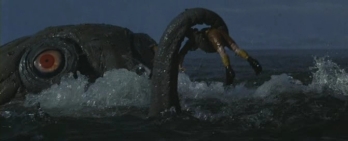
A pensive monster, looking for a moment of introspection.

Much like the giant, possessed squid that’s shambling across this island, mysteriously upright on its tentacles, Space Amoeba (1970) is a shambling wreck of a movie. The general conceit of this mess is that space aliens, having hijacked our first ship to Jupiter, have returned it to Earth, ended up in the Pacific Ocean near a quaint little island full of quaint islanders, which is scheduled for commercial development. They then “possess” (think The Exorcist (1973)) some innocent squid. Well, the movie calls it an octopus, Anyways, it mysteriously grows to be maybe 80 feet tall, makes landfall, can walk on its tentacles, kills a few people, tosses the head priest of the islanders about, and then exits the island holding its head as bats pursue it.

My Arts Editor’s favorite bad special effects scene. That would be victim #1 on the right, and our octopus on the left, experiencing a growth spurt after eating Mr. Doan’s Liver Pills.

One of the foreigners, a smarmy corporate spy, is next on the hit parade, while a crab and a sea turtle joins him as other members of the possessed. The spy doesn’t grow like the octopus, but the turtle and crab do. The possessed spy is the mole in the human community. Meantime, somehow the doughty humans have figured out that the dominating space aliens have one weakness, and it’s not that fungal problem afflicting bats. I’ll leave it to be the movie’s little secret. The humans blow the crab into an outsized meal, while the octopus and the turtle, attacked with the human secret weapon, lose their minds, attack each other, and eventually fall into a conveniently suddenly active volcano. The corporate spy, still dressed like a fop, manages to save humanity by throwing himself into the volcano after them.

Wow. It’s just awful. The turtle really just looked like a guy in a rubber suit. And the rest of the special effects were wretched. So was the acting, story, and audio. Oddly enough, I liked the space trip, and while I’m sure the “wide angle” shot showing the ship heading for Jupiter consisted of a photo of Jupiter pasted to a black board speckled with sparkles, I really felt like that might be what  you said. Too bad I didn’t find a frame of that portion of the flick.

But not much else.

Avoid.

Word Of The Day

syllogistically:

syllogism (Greekσυλλογισμός syllogismos, “conclusion, inference”) is a kind of logical argument that applies deductive reasoning to arrive at a conclusion based on two or more propositions that are asserted or assumed to be true. [Wikipedia]

Noted in “George W. Bush Raising Money to Maintain Trump Cover-up,” New York:

George W. Bush, who declined to endorse Donald Trump (or anybody) in 2016, and made muttered elliptical criticisms of the 45th president, has thrown himself into the task of covering up Trump’s many crimes. Bush, reports Politico, is raising money for candidates who are committed to maintaining the cover-ups.

To be sure, Bush doesn’t put it that way, and almost certainly doesn’t think of it that way. But it is syllogistically true. The Republican majorities in both chambers of Congress have followed a course of non-oversight, blocking disclosure of Trump’s tax returns, allowing him to to be paid by figures at home and abroad known only to him, and preventing investigations of multiple cases of misconduct. Working to maintain Republican control of Congress is ipso facto working to maintain the cover-ups.

The Voice Of Doom

A description of Hurricane Florence from meteorologist Eric Holthaus via WaPo:

Since modern tracking began, no hurricane with its origins in the hundreds-of-miles-wide patch of the central Atlantic where Florence traveled has ever made landfall on the East Coast, or even come close. Thanks to unusually warm ocean waters, Florence has intensified at one of the fastest rates in recorded history for a hurricane so far north. Thanks in part to unusually warm ocean waters between New England and Greenland, the atmosphere has formed a near-record-strength blocking pattern — not unlike the one that steered Hurricane Sandy into New York Harbor in 2012 — that is propelling Florence toward the Southeast coastline. Another blocking pattern, expected to emerge later this week over the Great Lakes, could lock Florence in place for days — which would result in an abject freshwater flood that could extend hundreds of miles inland.

Will it be enough to change some climate change deniers minds? Probably not. The problem is not the sort we’re equipped to even recognize, and some folks just can’t get over they’re preconceptions to understand that the world is changing all around them.

And, if this continues, their kids will have a lot worse set of conditions to contend with than current generations.

We Only Like Our Hoi-Polloi

There’s recently been quite a hubbub over the pressure being applied to Senator Collins (R-Maine) concerning the Kavanaugh confirmation hearings. In essence, a group is collecting IOUs from donors that will be burned if Collins votes against the Kavanaugh nomination, and will be collected and donated to Collins’ next re-election opponent if the Senator votes for Kavanaugh.

Reports have the total IOUs worth more than $1 million [WaPo].

The surface storm concerns the appropriateness of this approach to campaign finance. Senator Collins calls it bribery, and while I think that’s nonsense, it’s apparently getting some serious attention from legal experts.

But I don’t think that’s the real problem for the GOP. I think there are two underlying ideas that upsets them, or at least should upset them.

First, there’s the fact that this can happen at all. The people, who they’d like to claim to represent, just rose up and took a stand in opposition to a GOP-anointed SCOTUS candidate. Remember way back when Speaker of the House Ryan (R-WI) endorsed amateurism, the collective wisdom of the unwashed masses?

Well, if this funding effort is really constituted of small donors, then this is the unwashed masses kicking Ryan in the nuts.

But there’s another dynamic playing out here that I only became aware of this morning as I thought about Senator Collins’ dilemma, and it’s this: the types of donors to the political parties. While it’s true that both have what are termed mega-donors, it sure seem as if the Republicans are far more heavily funded by the mega-donor class than the Democrats.

A quick look at the table of mega-donors OpenSecrets vitiates my point slightly, but I think I can rebolster my point by citing the experience of Rep. Collins (R-NY) (no relation to the Senator to my knowledge) (yes, the guy who was just indicted on insider trading charges) with his donors, as noted by The Hill last year:

A House Republican lawmaker acknowledged on Tuesday that he’s facing pressure from donors to ensure the GOP tax-reform proposal gets done.

Rep. Chris Collins (R-N.Y.) had been describing the flurry of lobbying from special interests seeking to protect favored tax provisions when a reporter asked if donors are happy with the tax-reform proposal.

“My donors are basically saying, ‘Get it done or don’t ever call me again,’ ” Collins replied.

So what, you say?

So this: these mega-donors are, virtually by definition, individuals or small family groupings. These aren’t the hoi-polloi of which Speaker Ryan spoke in such confident and glowing terms. These are people such as Adelson and the Koch brothers and, presumably not for this election but verifiably in others, Betsy DeVos.

In other words, people with specific agendas that are quite often well out of the mainstream. DeVos, for example, is an outspoken advocate for for-profit and religious schools.

And this means the GOP is swinging back and forth, quite like the Sword of Damocles, where the thread is made of the opinions of all these mega-donors.

This crowd-funded financial weapon being waved in Senator Collins’ general direction, on the other hand, represents the opinions of many people, all agreeing on at least one thing: that Judge Kavanaugh’s opinions on abortion are incompatible with the American mainstream. By implication, that crowd of donors are also backing the Democrats. And it’s the multiplicity which virtually guarantees mainstream support for the Democrats.

The rise of the mega-donors is a great strength for a party, left or right, but it’s also an Achilles’ heel for them, because the outsize influence on the party’s direction and operation must be right – or it can wreck the party.

Does Everyone Burnout?

As I sat here tiredly digging through the news like any good citizen, I realized I’m feeling a little burned out by the whole political scene. And then I wondered if that’s true of just those who believe Trump is completely unqualified to lead this nation (quick, who said “Trump’s a moron!” while he was working for him in government!), or if the Trump true-believers also tire of him.

And then I ran across this from WaPo’sFact Checker column today:

“We have 25,000 people showing up to speeches.”

False. None of Trump’s post-election rallies attracted 25,000 people; most have been under 10,000.

That’s so interesting, isn’t it? Sure, 10,000 people is a lot of people – but it’s not really a noteworthy number, now is it? After all, he’s the President, he’s going to make America great again, people go gaga over him and demand God bless him[1]. Shouldn’t they be flocking to him in droves?

They don’t.

Maybe the Trump base tires of his childish prattle and grasping ways as much as we do. Polls show approval is heading back down. Judge Kavanaugh doesn’t have overwhelming support from the general populace, indicating more wariness of President Trump’s judgment.

Well, I’m still tired of him.


1A phrase I view with great fear, for if I’m wrong and there is a god, someday he’s going to get tired of being ordered to bless people and ZOT something will happen to one of the pious few, and I can only hope I’m not nearby.

Yes, I’m being facetious about there being a God. The rest I really do believe – ordering God to bless someone must be the height of hubris. Or is God just our little slave boy?

Your Price Increase Is …

There’s a few ways to spin this story from CNN/Health:

A pharmaceutical company executive defended his company’s recent 400% drug price increase, telling the Financial Times that his company had a “moral requirement to sell the product at the highest price.” The head of the US Food and Drug Administration blasted the executive in a response on Twitter.

Nirmal Mulye, founder and president of Nostrum Pharmaceuticals, commented in a story Tuesday about the decision to raise the price of an antibiotic mixture called nitrofurantoin from about $500 per bottle to more than $2,300. The drug is listed by the World Health Organization as an “essential” medicine for lower urinary tract infections.

“I think it is a moral requirement to make money when you can,” Mulye told the Financial Times, “to sell the product for the highest price.”

We could begin with the basic purpose of capitalism, which is not to make money, as Lehman Bros amply illustrated, but instead to participate in the activities of the private sector in order to supply useful products and services to consumers, both corporate and individual, and by doing so in an efficient manner earn some money. No mercantilism (the selection of winners and losers by an elite), just a form of meritocracy. Mr. Mulye clearly doesn’t understand these subtleties, but then many capitalists clearly do not, so he shouldn’t be particularly embarrassed. Generally, we hope that karma will kick in on people like him, and boot him in the head at some point have him discover, the hard way, that companies which take advantage of the vulnerable do not earn the love of the marketplace – and the marketplace is not the center of rationality that many like to think it is.

We could ask if pharma companies are really private sector companies, or if they’re medical sector entities operating with private sector optimizations to their operationality, which, as I’ve discussed over the years, are often less optimizations than distortions once they stray from their home sectors. This link may help the new reader. However, I think it’s important to realize that private sector health companies have provided many useful drugs, therapies, and devices over the years, and that the profit motive which I was just maligning does play a real role in pharma research, especially financing the expensive path from concept to final product.

Suggesting the banning of profit for pharma companies should be accompanied by suggestions for keeping these companies adequately financed and motivated. I suspect there’s a lot of academic research into just this problem, but I fear I have not the time to discover that research. A couple of problems immediately present themselves, one being the report motivating this post, another being the selection of problem to solve. Libertarians and others assume that demand will result in the proper problems being solved in the proper order, but my experience with the corporate world is that the cancerous idea that profit is all can result in corporate research strategies that are sub-optimal to the use of society. We’ve seen this in the abandonment of the production of anti-venom treatments because of the lack of profits in the area.

I’m not trying to suggest that everyone is motivated by the profit motive; there are many researchers who simply want to make a contribution to the overall health of the populace. But, taken as a conglomerate, it is how we operate, and we need to decide if that’s still how we should be doing things. Mr. Mulye is simply another step along the way to that debate.

Another spin would be to consider these opinions are symptoms of the ultimate sickness of capitalism. Again, mercantilism is an even worse system, infinitely more open to corruption and manipulation.

That’s enough for now.

Word Of The Day

Vainglory:

Excessive pride in oneself or one’s achievements; excessive vanity.
‘his vainglory put the Republic at risk’ [Oxford English Dictionaries]

Noted in “Christians are suffering from complete spiritual blindness,” Michael Gerson, WaPo:

In case this wasn’t clear enough, the document goes on: “We reject any teaching that encourages racial groups to view themselves as privileged oppressors or entitled victims of oppression. . . . We deny that a person’s feelings of offense or oppression necessarily prove that someone else is guilty of sinful behaviors, oppression or prejudice.” Christians, in the view of MacArthur and his fellow signatories, must condemn both “racial animosity” and “racial vainglory.”

Belated Movie Reviews

Roughage can be hard for a kaiju.

Feeling rather like a traditional British whodunit, I suppose Behemoth, The Sea Monster (1959, aka The Giant Behemoth aka The Behemoth) is best characterized as science-detective fiction grafted onto a kaiju movie. A man and his daughter, fresh in from fishing off the Cornish coast, pull into a cove, and she runs off to start dinner. He loiters a trifle too long after she leaves, and something … gets him. Hours later, his daughter and another fisherman find him as he expires, badly burned, muttering.

Before long a marine biologist and another scientist are investigating, pawing their way through various fishy specimens, and eventually discover there’s radiation involved. Soon they use radar (for an underwater object?) to track whatever it is, but that fails. A visual search comes to a grisly ending for those involved, which was a trifle unfortunate for the redshirts manning the helicopter sent out to look manually, as they get mysteriously fried, which is even more frustrating because we lose the best character of the lot, a slightly wacko paleontologist, in the incident. The military refuses to blockade the Thames, which for reasons unclear is where our agent of malfeasance is heading, and soon it knocks over a car ferry, terrifies the locals, and then submerges again.

Soon, we’re on a monster romp through London, but the scientists devise a torpedo with a radium tip, and, enticing the Behemoth back into the Thames, manage to shoot it into Mr. B’s head. The End.

Except … there’s reports of dead fish washing up on America’s East Coast.

Right up front, I’ll say that some of the science is screwy. Radar is not used underwater, that’s where sonar excels, for example. But the plot is very much an example of scientists gathering data, analyzing it, making educated guesses, and following through. There’s some cool stuff, even, for example when they discover an irradiated fish by placing it on a glass plate sensitive to radiation, and  it showing the fish’s skeleton.

Unfortunately, it’s hard to make scientific method exciting, and so the movie tends to be a bit of a plodder. When we finally do get a good look at Mr. B, it’s really a trifle disappointing, although I’ll admit the extreme closeups of his head did make me laugh. But the acting is OK, the story is good, and the monster is at least a bit temperamental about getting hit with electricity.

This doesn’t really qualify as horror, so don’t watch it expecting to curl your toes. In some ways, it’s a historical curiosity. I couldn’t possibly recommend it … but you might enjoy it if you’re of a certain turn of mind.

Just One Bad Tenet Can Spoil The Lot

I happened to run across this article in WaPo by Michael Gerson, calling out a recent joint statement authored by, among others, the conservative (or so Gerson says) pastor John MacArthur for betraying the legacy of the Evangelical movement. Recognizing the necessary shallowness of a mere newspaper article, I still found this bit from Gerson to be interesting, if dismaying:

Second, there is a matter of history. Elsewhere, MacArthur complains that evangelicals have a “newfound obsession” with social justice. This could be claimed only by someone who knows nothing of the evangelical story. During the 19th century, Northern evangelicalism was generally viewed as inseparable from social activism. Evangelist Charles Finney insisted that “the loss of interest in benevolent enterprises” was usually evidence of a “backslidden heart.” Among these enterprises, Finney listed good government, temperance reform, the abolition of slavery and relief for the poor. “The Gospel,” preached abolitionist Gilbert Haven in 1863, “is not confined to a repentance and faith that have no connection with social or civil duties. The Evangel of Christ is an all-embracing theme.” …

The MacArthur statement is designed to support not a gospel truth but a social myth. The United States, the myth goes, used to have systematic discrimination, but that ended with the Civil Rights Act of 1964. Racism is now purely an individual issue, for which the good people should not be blamed. This narrative has nothing to do with true religion. It has everything to do with ignorant self-satisfaction.

I know very little about the Evangelical movement prior to, say, when Jerry Falwell, Sr, became a prominent and self-righteous leader in the Southern Baptists, and even since then my knowledge is still fairly shallow. However, it’s not difficult to pinpoint the most important issue for the conservative elements of the Evangelicals as being abortion.

Speaking of which, on a recent visit to extended family I had the opportunity to overhear a conversation – no, a venting – of a member who is probably evangelical, but positively appalled at her fellow church-goers. The surface issue is their voting and support for Trump, but the deeper issue was the use of abortion as the single issue on which they judged candidates for office, and how. To their mind, it is a signal error on their part to cast their votes on that single issue, as if nothing else matters. I was not part of the conversation, but I do agree.

Source: Gallup

As anyone who pays attention national matters is aware, abortion is considered a considerable evil by a sizable minority of the American populace, and I’ve come around to the point of view that this obsession over one issue, an issue of debatable religious as well as secular (or utilitarian) result, is tormenting the Evangelical movement in its conservative pole into something unworthy of respect. Of course, this may be laid partially on the leaders of the movement, as the constituents of the movement certainly look to them for knowledge and leadership. However, people are not sheep, and should not act like such, because in so doing we are wasting our potential to be truly autonomous moral agents. Why is this awful? Think of all unjust wars of aggression, from the Nazis to the United States war on the American Indian, all of which require the actions of the followers to discard their moral systems, or fail to acquire them, and engage in slaughter and even genocide.

And thus the followers, as well as the Evangelical leaders, are responsible for the injustices they perpetrate in pursuit of their dubious goal.

How many are self-aware enough to realize how far they’ve strayed from the path laid down by their admirable predecessors, led by this devil’s issue? That’s the question that preys on my mind.

I’ll Know I’m In Trouble

Having just seen Colbert’s interview of Bob Woodward a few minutes ago, I’ll know I’m in trouble if he shows up at my door. Goodness, sharp as a pin, he is, and devious in his interviewing strategies.

I hadn’t planned on reading FEAR, but now maybe I shall.

Or A Brutal Riposte

Reuters is reporting on standard political shit by the Republicans:

With congressional elections looming, Republicans in the U.S. House of Representatives on Monday proposed more deficit-expanding tax cuts, an effort seen by some tax experts as unlikely to become law and geared chiefly toward winning votes.

Even if the initiative fails to pass, it could put Democrats in the position of opposing the new tax-cut plan on the House floor, which Republicans could seek to use to their advantage in the Nov. 6 elections where control of Congress will be at stake.

Under the measure, federal individual income tax cuts approved on a temporary basis by the Republican-controlled Congress and President Donald Trump in December would become permanent.

It would also eliminate the maximum age for some retirement account contributions and let new businesses write off more start-up costs.

Nothing particularly objectionable about the maneuvering, but as Steve Benen points out:

Even if we put aside the many substantive concerns – including the fact that GOP officials aren’t even trying to come up with a way to pay for another round of tax cuts – the politics aren’t as clear as Republican leaders would like.

If they continue to not find ways to pay for this – by, say, cutting the Defense budget, which I happen to think is bloated – then Democratic incumbents can respond to attacks by Republican challengers on the issue by saying, You bet your ass, the Democrats were the adults in the room, recognized the national debt is going to ruin us, and we refused to do that. Mr. Challenger, in view of the mess that happened in Kansas when they did what you proposed to do, how can you possibly justify your support for this disaster?

In the case of obverse, the Republican candidate so foolish as to vote for this tax reduction will also face a withering volley.

Appealing to the true fiscal conservative, who is aware that our national financial ruin would result in inflation that would destroy any minor pickups in income for the average individual, and that the Laffer Curve is a theoretical fallacy at worst, and at best only works in certain situations, is the best bet. Being freaking made that the GOP is putting our nation’s future financial health at risk just to get  a few votes is both sincere and appropriate, in my view.

Two Data Points Isn’t A Trend, Ctd

And now we have a third data point to add to the trend of Republican corruption. The AP reports on Representative Rod Blum (R-IA):

A congressman from Iowa violated House ethics rules by failing to disclose his ownership role in a new company, a mysterious outfit that featured his top federal staffer in a false testimonial promoting its services, an Associated Press review shows.

Rep. Rod Blum was one of two directors of the Tin Moon Corp. when the internet marketing company was incorporated in May 2016, as the Republican was serving his first term, a business filing shows. Among other services, Tin Moon promises to help companies cited for federal food and drug safety violations bury their Food and Drug Administration warning letters below positive internet search results.

Blum claims it to be a clerical error. How corrupt is this? Not really all that … oh wait. It gets a bit worse.

Tin Moon’s website on Tuesday removed an official photo of Blum wearing his congressional pin and changed his title from CEO to “majority shareholder” after AP raised questions about ethics rules. Tin Moon is based in the same Dubuque office as a construction software company Blum owns, Digital Canal.

And then:

Late Wednesday, the company also removed an online video testimonial showing “John Ferland representing Digital Canal” and claiming to be a satisfied customer. Ferland — who is actually chief of staff in Blum’s congressional office and has never worked for Digital Canal — claimed that Tin Moon is “saving us thousands of dollars every month, keeping our traffic and leads higher,” and implored: “From one business owner to another, I suggest you take a look at Tin Moon.”

Assuming the AP has its ducks in a row, this is rather like cockroaches scurrying for their dark little holes when someone turns on the lights, isn’t it?

The omission of mentioning his ownership in the company seems quite odd. How can one forget about a company one has a financial interest in? And then Blum depicted as CEO with his Congressional title clearly shown – quite Roman, one might say, that hint of power and influence. I wonder if he was aware of it. The video, in comparison, is simply crass and deceptive. Blum later suggests he has no idea how that happened, which is doubly disgusting. You’re the majority shareholder, try being an adult about it.

The frenzied removal of evidence, as if that will help matters. It’s just so … I’ll chance the overused banal, although I sense that word is going by the wayside.

The timing is interesting, too, as while Representatives Hunter & Collins are in relatively safe Republican districts, although I can’t help wonder if they’re less safe now, Blum is in a relatively competitive district according to Ballotpedia, having won his last election 53.7% to 46.1%, and while it went for Trump in 2016, in 2012 it went for Obama.

So this ethical contretemps may result in a loss of another GOP seat, and, more importantly, contributes to the damage being accumulated by the Republican Party.

An Imminent Crackup? Ctd

It appears the transition of power in Saudi Arabia is not going well, as I mentioned here earlier. Bruce Riedel adds to the analysis in AL Monitor:

Saudi Vision 2030, the brainchild of Crown Prince Mohammed bin Salman to reduce the kingdom’s dependence on oil income, is coming undone. The king has stripped away the central pillar of the project. The country is becoming more autocratic and repressive. The slide toward greater repression is prompting capital flight.

The centerpiece of the ambitious plan was to open up Aramco, the national oil company, to outside investors. Five percent of the company would be opened initially, creating an initial public offering, or IPO. The crown prince estimated that the company would be valued at $2 trillion, creating the world’s largest IPO of $100 billion.

Incidentally, capital flight leads to economic upset. If it’s traced to an autocratic takeover, it makes for an easy target for overthrow – and worse. But if a democracy engages in acts that result in capital flight, then those in control either must control the press or the democracy is in danger of going under – especially if Democracy is considered the problem, rather than foolish activities of a few.

The crown prince’s so-called anti-corruption campaign last November — in which hundreds of prominent Saudis, including members of the family, were detained and forced to hand over assets to the government — added further difficulties. The shakedown underscored the absence of due process and the rule of law in the kingdom and discouraged foreign investment. It also sparked major capital flight as the wealthy sought to protect their assets abroad. One authoritative estimate is that almost $150 billion in capital has left the kingdom in the last two years. …

The arbitrary detentions last fall and now of women are part of a broader trend of greater authoritarianism and repression in Saudi Arabia. Saudi Arabia has always been an absolute monarchy that stifles dissent. There is no freedom of assembly or speech. Public executions are a mainstay of Saudi life.

But the repression is getting worse. The shakedown last year was unprecedented in Saudi history. Some of those detained are still under arrest. Public executions are more frequent. Prominent clerical critics have been rounded up.

And etc. If the Saudi Arabian monarchy falls over, there’ll be some rearrangements in terms of power and alliances in the Middle East. Don’t assume Iran will benefit from disarray at its primary rival in the region, either, because they have a big bucket of economic & environmental troubles of their own.

Looks like this region could get more interesting in the next few years. Another reason to lessen our dependence on oil.

The Environment Matters

NewScientist (1 September 2018) reports on pollution and the collective you:

An analysis that compared local air quality with cognitive test scores from nearly 32,000 students in China has found that a 17 per cent increase in measures of air pollution is linked to a 6 per cent decrease in verbal skills and a 2 per cent decrease in mathematics performance (PNASdoi.org/ctc3).

Air pollution may damage the brain through several pathways at once, says Xiaobo Zhang at Peking University in Beijing, who was involved in the analysis. Other research has shown that pollutants in the air can carry toxins into the brain, decreased oxygen supply caused by pollution may impair cognitive functions, and prolonged exposure to unclean air can lead to neurological inflammation and disease.

While 2% may fall into the error bars, 6% may not. And this makes sense, since our brains evolved in a very different atmosphere. In fact, it’d be interesting to know if the higher percentage of CO2, relative to when we evolved our brains, is also having a deleterious effect on them as well.

Belated Movie Reviews

Nummy nummy in my tummy!

The surprisingly good The Lost World (1925) is the classic Arthur Conan Doyle story of the same name, but we found this particular silent film version on Amazon Prime.  The movie we saw is a collage of 4 different prints, all damaged. This may account for some of the odd gaps in the story.  Still, they claim it’s longer by half than any of the single reels they used to put this version together.

We start out with the venerable Professor Challenger, having returned from his first trip to the mysterious South American plateau supposedly hosting dinosaurs, with wild claims but no evidence. Jeered by rowdy students at a presentation, he calls for volunteers to return to the plateau, and he gets Sir Roxton, the hunter, Professor Summerlee, a critic, and Malone, the journalist looking for a risky adventure qualifying him for the love of beautiful Gladys. Accompanying them will be Paula White, daughter of Maple White, who was left behind on the previous expedition, fate unknown.

Upon arrival at the plateau, they soon see a pterodactyl in the distance, and while marveling at that, an ape tries to bombard them from the plateau above. Making the ascent, soon Summerlee is convinced of Challenger’s claims, but their way back down is lost when a dinosaur knocks over an opportunistic bridge. Scrambling now for survival among the brontos, stegs, triceratops (there is no cute abbreviation for such a word), and those “pests of the prehistoric world,” allosaurs, a volcano begins to go off. A rope ladder is sent up by their base support group, and they scramble down it to safety, even as our mystery ape tries to disrupt their escape, having the sorrowful news of the death of Maple White.

During this time, a bronto survives a fall into a lake at the base of the plateau (I believe my Arts Editor suggested it should have gone splat!), and Challenger arranges for its return to London. At unloading time, it breaks loose, and makes for the Thames, leaving Challenger with nothing but stories and an outraged populace. Meanwhile, Gladys has married (“he’s a clerk!”), leaving Malone free to marry Paula.

This was actually fun. The special effects are old-fashioned, but they’re surprisingly effective. I’d never think a bronto would go for the throat of a predator like an allosaur. The black and white in this version is leavened with various color washes. The dialog, on the traditional interleaved placards, is kept on the screen a pleasantly short amount of time, and if there’s no insightful theme, we still had a good time watching it.

Ethics & Voting

While reading Andrew Sullivan’s latest column concerning the insanity in Washington, I was reminded about an article on ethical voting I saw a while back. First, let me cite Andrew’s article, which at this point is discussing the anonymous op-ed:

If Anonymous quits, he will only empower the president’s worst anti-democratic instincts, and make way for someone else who will likely enable authoritarianism. If he stays, he is undermining the very democracy he is trying to protect, by conducting what is effectively a soft coup on behalf of the “steady state” and that part of the GOP that decisively lost to Trump in the primaries.

And that lead me to consider the problem of that part of the GOP that lost “decisively” in the primaries to Trump-backed candidates. If you’re a never-Trumper conservative, who should you be voting for, or even voting at all? The article on ethical voting is, I believe, this one in Quartz, and has the following passage:

“As a citizen, I have a duty to others because it’s not just me and my principles, but everybody,” says [philosophy professor Michael] LaBossiere, who favors the utilitarian approach. “I have to consider how what I do will impact other people. For example, if I was a die-hard Bernie supporter, I might say my principles tell me to vote for Bernie. But I’m not going to let my principles condemn other people to suffering.”

And the current contretemps of the United States, if we individually recognize it, is certainly illustrative of the truth of that paragraph, isn’t it? Upon those who voted for Bernie, those who might have voted Democratic but didn’t vote at all because of some concern over Hillary, as well as those who voted for Trump, falls the blame for the damage being done to the foundations of our liberal democracy, from the fallacious attacks on the free press to our international relations and alienation of key allies, while enabling the malign ambitions of the Russians.

If you’re shaking your head in denial, I’m sorry, but it’s true.

The narcissistic nature of today’s American society is, I suspect, partially to blame. I say this from the viewpoint that, because it’s a single vote, how much impact can it have in a State of some millions? I know that I’ve personally argued on an occasion or two (prior to the opening of UMB) that the worth of the individual’s vote is not in its use, but that it exists as a passport to participation in society’s institutions. But it should be now clear that it must be exercised to be fully qualifying for that access to institutions.

Moreover, it’s a selfish viewpoint, because it presupposes that we must have an individual, substantial impact with that vote, or it’s not worth exercising. But the fact is that we have just as much electoral impact as the millionaire in his mansion, and that should be a source of great joy, because in our previous incarnation as an English colony, that millionaire, that member of a more elevated class, really did have more impact than the common guy in the street. The consequence of that was a society preoccupied with the higher classes, and resulted finally in the Revolution.

With the privilege of voting and participating comes the responsibility of voting for the best possible outcome. This doesn’t mean simply evaluating each candidate for fidelity to your values, or who makes the most expansive promises, but finding that candidate who has demonstrated competency in governing, who has ideals and goals at least somewhat compatible with yours, and has a chance of winning.

Being too disgusted to vote sounds sexy, even realistic, but in the end it’s an abdication of responsibility, particularly when it means you don’t vote at all, rather than skipping a particular race. Take the time to research and evaluate, because that’s part of being an American citizen – you are seriously offered an opportunity to help select our leaders, why blow it off? Because you’re lazy? Unacceptable. Because none of the candidates meet your standards? Maybe you should be out there researching what it would take to run yourself – and maybe you’ll learn a thing or two about those very issues you thought weren’t addressed properly.

As hard as it is to accept that your 3rd party candidate isn’t going to win, it’s usually the reality, and if you want to make a true contribution to the task of governance, voting for that 3rd party candidate may enable the candidate you really didn’t like to win the race.

That’s how our electoral system currently works.

Perhaps we should be discussing ranked voting as a replacement system for all races, as they’ve started using in Minneapolis, but that’s another post. We have to work with what we have, and if you refuse to recognize that reality, then you’re part of the problem.

Not part of the solution.

Word Of The Day

Metacognition:

Knowledge about the accuracy of our knowledge is a facility called metacognition. Requiring self-awareness and introspective judgements, it is used in many everyday decisions. For instance, we might decide to invest money in a new venture because it seems promising, but choose not to risk much capital because we realise we might be mistaken. [“We can train ourselves to be better at knowing when we are wrong“, Clare Wilson, NewScientist (1 September 2018, paywall)]

This Hole Looks Deep, Ctd

Remember deepfakes, the anticipated production of video fakes that are difficult or impossible to detect? NewScientist (1 September 2018, paywall) reports they’re here:

A FAKE is only as good as it looks. And while forging a counterfeit handbag or watch takes time and effort, churning out fake videos has become surprisingly easy.

A new system can turn a few simple animated line drawings into realistic fake clips in high definition. The software is open source, meaning it is available to anyone – and it has reignited concerns that such tools could be used to warp our perception of the world. …

The resulting footage can be produced at 2K resolution and looks startlingly lifelike. Examples the team has produced include street scenes, and people talking or performing dance moves (arxiv.org/abs/1808.06601).

“It is sort of stunning, the progress that has been made,” says digital forensics expert Hany Farid at Dartmouth College in New Hampshire.

This type of video has become known as a deepfake, and fake videos of world leaders, such as Donald Trump and Theresa May, have been created using similar techniques. A community dedicated to creating faked pornography videos containing famous actors has sprung up too.

In case you don’t think this is a big deal, even prior to the development of this system, people have died because of the distribution of fake videos:

Fake videos have been implicated in the deaths of more than 20 people in India. This started after a video clip showing two men on a motorcycle snatching children on the streets went viral on WhatsApp.

The video was originally a public service announcement in Pakistan to raise awareness of human trafficking. However, it was edited to remove the message at the end. The clip was thought real, and widely spread WhatsApp messages pointed the finger at organ thieves disguised as beggars, which sparked public outrage leading to mob killings.

Essentially, assassinations, metaphorical and real, can now be arranged by the malign simply through distribution of a video of something that never happened, because they can depend on the mob mentality to complete the job.

That will be true until society decides in a collective manner, no doubt only enough people are dead or ruined, to no longer trust a video. Electronic recordings of the visual aspect of reality are now transitioning from somewhat trustworthy to not trustworthy at all.

Impacts? I count the following:

  • Courts will try to accept only those recordings for which the provenance is known and trusted, which they do to some extent already, but I suspect this will grudgingly be lost as more and more courts are fooled by technologies such as this.
  • The continued growth of an art form in which real people are placed in fictional situations. This is already happening, but as more and more artists become involved, it will evolve into who-knows-what.
  • A drop in the sales of real cameras as current and potential customers become disgusted by the entire phenomenon of recording reality.
  • The use of this technology to question the very authenticity of someone’s identity through the production of suicide videos depicting the death of people who have not died. Regarded as nuisance crime, at its most basic it’s an assassination of someone’s life, similar to today’s identity theft. The addition of difficult-to-identify bodies which may correspond in some way to the victim of this crime will make the situation especially difficult – and spawn an industry in which people are actually murdered in order to supply bodies for the virtually murdered.

Will we turn completely away from recordings of the visual aspect of reality as a society? Or will we find that technological solution in order to save this world-wide custom? I look forward to finding out.

WaPo’s Thomas Kent has a few thoughts on the subject, wrapping up with this:

Unless the dangers of fake video receive broad public attention now, the public will be caught unaware when truly convincing fakes appear, perhaps with disastrous results.

Finally, in publicizing the dangers, media need to avoid a tone of hopelessness — “Soon we may never know what is real and what isn’t.” Quality media outlets need to emphasize how carefully they vet video. They should make sure their ethics codes and verification procedures adequately address the dangers. Otherwise, audiences will doubt any video — including legitimate and important footage that media outlets gather in their own breaking-news coverage and investigative work.

Kent still has hope to salvage the video recording, but he does acknowledge the possibility of it being completely lost.

And just for your delectation:

It’s gonna get worse, folks.

The President May Have The Wrong Point

NBC News is reporting that President Trump wants Attorney General help track down the author of the notorious op-ed:

President Donald Trump said Friday he wanted Attorney General Jeff Sessions to launch an investigation into who authored the explosive anonymous opinion article published in The New York Times earlier this week.

“Jeff should be investigating who the author of that piece was, because I really believe it’s national security,” Trump told reporters aboard Air Force One.

The op-ed writer, identified only as a senior administration official, said some members of the administration are trying to thwart Trump as part of a “resistance.”

Steve Benen remarks:

The trouble, of course, is that Trump’s call doesn’t make much sense. In order for the New York Times opinion piece to warrant scrutiny from the attorney general, there would need to be some kind of evidence of a federal crime. There isn’t. We’ve all read the op-ed and it does not describe illegal misconduct.

It also doesn’t point to any national security threats, unless one is inclined to accept the op-ed author’s concerns at face value and conclude that having an unfit president is itself a national security threat.

I think the first paragraph of Steve’s analysis is a mis-fire, or a mis-print. The question is whether the letter itself is illegal.

But remember the flavor of the moment a few weeks ago, Non-Disclosure Agreements (NDAs) signed by White House staffers? It’s possible that Trump wants Sessions to investigate for abrogation of those agreements. Once again, Trump tramps close to a precedent he’d hate if he tries to punish a transgression of a questionable legal agreement, because a court might easily find those agreements to be non-binding.

But, given the insulting picture it paints of the President, how can he not lose his cool on this letter? It’s probable, as I’m sure many other observers have noted, that the author of that op-ed is intentionally provoking the President in hopes of alienating his base, or committing a political crime gross enough to bring Congress back to its senses.

I think this chances of either happening are miniscule.

And, on a less serious note, I’m having mad visuals of the only way the author will be found by Trump is if the guy can’t repress his giggling at his desk.

That Darn Climate Change Conspiracy, Ctd

It must have been a conspiracy that caused this tsunami, as noted by Higman, et al, in an abstract in Nature’s Scientific Reports:

Glacial retreat in recent decades has exposed unstable slopes and allowed deep water to extend beneath some of those slopes. Slope failure at the terminus of Tyndall Glacier on 17 October 2015 sent 180 million tons of rock into Taan Fiord, Alaska. The resulting tsunami reached elevations as high as 193 m, one of the highest tsunami runups ever documented worldwide. …

Our results call attention to an indirect effect of climate change that is increasing the frequency and magnitude of natural hazards near glaciated mountains.

Any ground-based eye-witnesses would be dead, of course. In fact, a drone hovering above would probably have been wrecked by air currents induced by the tsunami.

The impending drowning of various sea ports and other coastline cities is the true big story, of course, followed by changes to agricultural patterns, but incidents such as this one are terrifying reminders of the power of physics and how it ignores all the delusions of humanity.