

(h/t NewScientist 2 May 2015)
A rhetorical question, to be sure. Still, given the flood of news coming out of North Carolina over the last few years, it’s certainly worth gathering it together, scratching one’s noggin, and muttering, “Hmmmmm!”
Onwards….
TOXIC
Care must taken to define the subject in order to reach a reasonable conclusion: for example, basing a definition upon the fringe personalities contained within the states would reveal most of the country as being toxic, as we’d find Palin from AK, Bachmann from MN, Walker from WI, Cruz from TX, and Warren from MA as just a few examples which would only enrage perhaps even the moderates. As entertaining as I’d personally find this approach to be, it must be abandoned.
So a definition of “toxic”, designed to take the topic seriously, should be rather more objective and well-reasoned: I suggest an environment, enforced by the political powers-that-be, in which the youth in that jurisdiction are receiving educational and casual instruction which will result in adults deficient in knowledge of how the world works, and a defect when it comes to competition with other young adults.
SCIENCE
In our modern world, Science, the study of reality, has become the substratum upon we have built the institutions which render modern life a reality: vaccines, agricultural techniques, and telecommunications are just three of the technologies that are the result of the such scientific fields as quantum mechanics, evolutionary biology, and genetics. Science is composed of, among other things, two concrete concepts: the process it uses to formulate hypotheses and test same; and the store of scientific facts, always contingent, upon which hypotheses are reasonably built and assessed. Less tangible aspects include the creativity which gives the scientist insight and, in some cases, an awe commonly associated with those who study the divine.
In our context, the question is how is Science treated in the state by the powers that be? Is it a useful, trusted source of information concerning reality? Or is it ignored, cherry-picked, and even manipulated to provide answers acceptable to those asking the questions?
SCHOOLS
These are the institutions we use to convey the foundations of knowledge, and, later, science to our offspring. These are the key institutions, from kindergarten to the production of PhD-level adults. It is these people who will ultimately farm the land, innovate the new medicines, and create the new technologies which we’ll learn to hold dear. If the institutions of schooling are not sound, then their output will not be sound.
All that said, school evaluation is difficult. Even those who compile relevant statistics ask they not be used to rank schools and states because of influencing factors: local affluence, environment, and teacher pay are just some of the factors which may interfere with a fair evaluation of an education system. Evaluation of school performance, and possibly more important, evaluation of the support of a school system can be a tricky subject.
So statistics must be approached with caution. Nationwide comparisons are nearly non-existent, so one must carefully select how one evaluates data.
GOVERNMENT
Government must be on the most solid of grounds, as it provides the rules, enforcement of the rules, and the glue to hold together a sometimes divisive society, providing help where needed against the inimical forces of Nature. This calls for honor, ethics, integrity, and ultimately the proper utilization of the results of science.
HOW DOES NORTH CAROLINA STACK UP?
SCHOOLS
As noted, achievement is hard to meaningfully measure. The State Board of Education claims
North Carolina’s…
…four-year high school graduation rate is 83.9 percent, the highest in state history.…Career and Technical Education completers’ graduation rate is 94 percent.…annual dropout rate is 2.45 percent, the lowest in history.
North Carolina public schools are»Among the top 11 participating education systems in theworld for 4th & 8th grade math scores on the Trendsin International Mathematics and Science Study (TIMSS)»16thin the percentage of seniors who took atleast 1 Advanced Placement exam in high school»14th in the percentage of seniors scoring 3 or higheron Advanced Placement exams in high school»18th in 4th grade math, according to the NationalAssessment of Educational Progress (NAEP)»29th in 4th grade reading, according to NAEP»23rd in 8th grade math, according to NAEP»37th in 8th grade reading, according to NAEP»Among the bottom 10 states in per pupil funding»46th in teacher pay
Another measure of schooling in the K-12 system is the salaries of teachers, and at first blush it doesn’t look good. NPR contributes this report on the sudden fall in salaries:
No state has seen a more dramatic decrease in teacher salary rankings in the past 10 years, and some of the other changes in public education are unprecedented. The state is being watched closely by education policymakers across the country, and teachers are suing the state.
Terry Stoops directs education studies at the conservative John Locke Foundation, a Raleigh, N.C.-based think tank.
“They did it all at once,” Stoops says. “They don’t get style points for it, but the number of reforms that were passed received some awe from some of my colleagues in other states that said ‘I can’t believe that North Carolina was able to do all that in one year.’ And in particular, the elimination of the master’s degree supplement.”
So conservatives are pleased, but then they’ve conducted a war on teachers and their unions for as far back as I can recall; no doubt they may have started with good reason, but one must be careful with an institution this important. Especially disturbing is elimination of the master’s degree supplement: so you improve what you can offer to your students, and you don’t get rewarded for it?
How do teachers in North Carolina feel? Also from the npr.org report:
“Morale is at the bottom of the barrel right now throughout this state,” [Rodney Ellis, president of the North Carolina Association of Educators] says. “Teachers are really questioning why they want to teach, why they want to teach here in North Carolina. They have to take care of their own families, and it’s difficult to do that when our salaries are as low as they are. We’ve got educators who right now qualify for government assistance.”
I can attest, from personal contacts, that this appears to be a true statement.
The local ABC affiliate WTVD provides the following truly disheartening summary:
Among the study’s findings, North Carolina ranked 51st in ten-year change in teacher salary; 48th in public school funding per student; 47th in median annual salary; 43rd in teachers’ wage disparity; and 40th in safest schools.
Wallethub provides similarly dismal data with North Carolina in plumb last. Starting salaries do little better, although it’s not clear if the data has been adjusted for cost of living.
From personal report, teaching assistant positions are also under attack, which, if successful, would leave teachers with that much more to do. This can also be seen in the above chart.
On top of the North Carolina-specific ills, the teachers must also put up with the nation-wide controversy of testing, as described in this recent New York Times article. I hesitate to further pursue this topic in a post on North Carolina, so let me be brief, with a reference to a teacher’s viewpoint in Oklahoma (I am assured by teachers in North Carolina and Minnesota that the viewpoint applies nationwide):
For most of us parents, the first impression that we have of school is that it is a warm, welcoming place. It’s because that first impression comes from viewing the Kindergarten class on an occasional basis when our children first start school.
And for most of us, that impression continues on into the middle school years.
But for most of the teachers and administrators today, the elementary school turns into a hostile workplace during the Spring testing season.
The balance of the above link is worth a read.
And what of the college level schools? The previous NPR report asserts without documentation:
But bigger problems loom for the future: Freshman enrollment in the state universities’ education schools is down between 20 and 40 percent.
Never mind the recently revealed athletics scandal at North Carolina – Chapel Hill, it’s really small beans. If prospective students perceive your college level schools of education as undesirable, what does that say about the state as a whole?
GOVERNMENT
One of the keys to a placid society is the perception that fairness is at the foundation of the society; those who feel unfairly treated do not have as much of a stake in the continuance of society as constructed; those who construct such societies then must fear the fell end of their efforts.
SCIENCE & GOVERNMENT
North Carolina has become infamous, at least in science circles, for its outlawing of ‘climate change’. Scott Huler at the Scientific American blog Plugged In provides a useful interpretation of the law in question:
That is, the meter or so of sea level rise predicted for the NC Coastal Resources Commission by a state-appointed board of scientists is extremely inconvenient for counties along the coast. So the NC-20 types have decided that we can escape sea level rise – in North Carolina, anyhow – by making it against the law. Or making MEASURING it against the law, anyhow.
Here’s a link to the circulated Replacement House Bill 819. The key language is in section 2, paragraph e, talking about rates of sea level rise: “These rates shall only be determined using historical data, and these data shall be limited to the time period following the year 1900. Rates of seas-level rise may be extrapolated linearly. …” It goes on, but there’s the core: North Carolina legislators have decided that the way to make exponential increases in sea level rise – caused by those inconvenient feedback loops we keep hearing about from scientists – go away is to make it against the law to extrapolate exponential; we can only extrapolate along a line predicted by previous sea level rises.
ABC News provides additional perspective on the personalities involved; suffice it to say a climate change denier with financial ties to projects on the coast of North Carolina is involved. It is … disturbing to see a mix of financial dealings and ideology used to override good sense as provided by the best scientific findings. Suppose the climate change hypothesis is true: what will become of the structures built under government assurances that flooding of the sort that could damage those structures is unlikely to occur?
They may be depending on Federal help in case they get in trouble, using the Federal Government’s National Flood Insurance Act of 1968. This program offers flood insurance to coastal residents in partnership with private insurers; this program exists because otherwise private insurers declined to offer insurance, certainly a red flag. A 2012 New York Times article stated that, at that time, the program was $18 billion in debt, and not expected to ever recover those costs through premiums. Total vulnerable assets insured? $527 billion. The article advocates for the abolition of the program on the grounds that those who wish to live near the coast should bear the costs when we can now predict that, if inputs to the atmosphere continue, that flooding is a near certainty. This is a sensible, even conservative, position to take, since living on the coast is not a necessity of life, merely a preference – and flooding of the coast is now a predictable event.
Unless, of course, you’re North Carolina. Confidence in government is low (roughly 24% in the Federal government, according to this nifty graph at Pew Research); imagine what will happen when the North Carolina government’s projections are found to be wrong, based on obsolete models mandated by the government.
GOVERNMENT FAIRNESS
And is North Carolina fair? Democrats outnumber Republicans roughly 2.6 million to 1.9 million, with 1.7 million unaffiliated, yet 10 of 13 Congressional seats are currently Republican. Perhaps the Independents went Republican in a big way in the last election. Or perhaps not: SCOTUS has rebuffed the North Carolina’s Supreme Court decision that gerrymandering did not take place on the latest redrawing of district lines.
Next is the news of Republican attempts to gerrymander the state even at the local level. This may be a traditional practice, but when the Republican Governor speaks out against these Republican plans, you know something out of the ordinary is being practiced. Rigging election districts to this extent may be considered systemic corruption.
And, finally, there may be nefariousness hidden in the bowels of state government. This report is still in the arena of speculation, but suggests that during the administration of Governor Pat McCrory there have been chronic shortfalls in the registration of new minority voters:
Finding 1: A systematic sharp decline in new voter registrations originating from Public Assistance (PA) programs began on or about January 2013 and continues to this day
Keep in mind, these are merely results from analysis of voter data, and have no legal existence at the moment; but they remain alarming, and the story is fast developing – this update notes that North Carolina’s Department of Health and Human Services may be in violation of Federal law when it comes to helping their clients register to vote. This is all very unsettling.
To reiterate, one of the keys to a placid society is the perception that fairness is at the society’s foundation; those who feel unfairly treated do not have as much of a stake in the continuance of society as constructed; those who construct such societies then must fear the fell end of their efforts. How do North Carolinians feel about their leaders?
(h/t Joan McCarter @ The Daily Kos)
SCIENCE & BUSINESS
If your state is not emphasizing solid science, then any business dependent on science must question whether they can prosper in such an environment. We’ve seen the hostility of NC government to [that] science which their ideology finds unpalatable, but ideology is not the bedrock of our society. Indeed, ideology not rooted in reality is nothing more than chalk waiting to be disintegrated by the waterfall. And NC’s waterfall may be the sudden uprooting of such large businesses as Wells Fargo (it swallowed NC’s Wachovia during the Great Recession) from Charlotte, Bank of America, and BB&T. These large financial corporations are dependent on technology, and technology is built on good science. If they realize they are in a state hostile to science, they can – with some effort – pick up and leave. And the NC legislature can try to make a law banning such moves …
CONCLUSION
Is North Carolina the most toxic state in the union? It is a judgment best left to you, dear readers; for those who have a seat within the polity, who can see the dirty linen underneath the dancing skirts of the high kicking government officials; and for those of us whose domicile is without, where perhaps we see more of the whole without seeing the cracks in the gears of the great machine.
In “Critical Cartography” on berfrois, Rhiannon Firth makes a strong case for maps having a moral component, in contrast to my views on moral components and man-made objects:
A critical cartography is the idea that maps – like other texts such as the written word, images or film – are not (and cannot be) value-free or neutral. Maps reflect and perpetuate relations of power, more often than not in the interests of dominant groups.
It is fairly easy to think of some ways in which maps embody power relations. One need not dig too deep within the history of mapping to see that they are intricately tied up in the history of nineteenth century colonialism and imperialism. Cartographers drew – and continue to draw – boundaries that separate people and resources. As another example, it is a fairly well-known fact that the commonly used Mercator projection of the globe is an inaccurate representation, because when cartographers ‘flatten out’ the spherical earth, they need to make certain choices: Size, shape and distances cannot all be maintained in the process. In the Mercator projection, the global North is vastly expanded at the expense of the South and Europe is placed squarely in the centre. As a further example, we may find it relatively easier – using an Ordinance Survey or Google Maps – to find a recently built supermarket than a longstanding squat, autonomous space, social centre or other radical space, or perhaps the site of the Battle of Hastings rather than the site of a historical radical struggle or riot. This does not just have practical implications for finding a space. Maps structure and limit our knowledge of the landscape, affecting our perception of what is important, the relative sizes and relationships between objects and spaces and where it is possible or safe to travel.
So I’ve been mulling this over. I still don’t see how a bolt is a moral object. A map is a different thing, if you permit it a tangible reality, which I think is inevitable; while digital maps may be more common, maps in physical media used to be dominant. I am less than an amateur philosopher, which is to say I’ve not read formal philosophy in a decade or so. I suspect we could place maps and bolts in different categories, but I don’t see the critical component of their existence; I tried to argue that a map is the result of a human intelligence, but the counter argument is too obvious.
Perhaps it’s more fruitful to change the argument from human intelligence to an expression of human opinion. This is more interesting; while one may argue that a bolt is also the expression of human opinion, there is a critical difference. Intelligence is a dubious term, as definitions for it differ from year to year. Opinion is somewhat more definite:
a belief or judgment that rests on grounds insufficient to produce complete certainty.
I would add, an opinion need not conform to reality, nor even the true views of the expressing entity. So let’s apply this to a map: the map may still prove useful, particularly if its false opinions do not lessen the efficacy of its purported purpose. So if certain information is omitted, as Rhiannon suggests happens with great frequency, then the map is deficient in that knowledge vector, but if the map’s purported purpose is in another knowledge vector, then the map remains useful even as it obscures certain information which may prove important in other contexts.
But if a false opinion is expressed in the production of a bolt, it’s such a definite, single purpose object that it would definitely fail in its purpose. So I’d have to say that the more an object may embody false opinions without damaging its fulfillment of a purpose, the more of a moral component may be said to be embodied in it.
So … tilting at minutiae? Hard to say. I also would like to say that I simply enjoyed Rhiannon’s piece. In fact, this is why I blog – I run across something that makes me think, that reveals a new angle on something. And then I get to share my thoughts on it. I’d definitely recommend reading her piece.
My arts editor said, “But the skins themselves do have an artistic element, even if they ARE covered in poop.” OK. I like 3D printers. But I’m not sure if this is art, only art, art with practical usage, or just another person who does odd things and calls it art.
You tell me.
Today, Stratasys announced that Oxman has achieved her goal and unveiled her latest creation Mushtari on the stage of TED2015 in Vancouver. The pieces are created not only to allow for living organisms to inhabit them, but also to intentionally manipulate the functions of those organisms. Don’t worry, this isn’t the herald of some dystopian state in which human beings are called ‘organisms’ and enslaved by 3D printed suits. Instead, the occupants are microorganisms such as cyanobacteria and E. coli.
Responding to this post, a Facebook correspondent writes:
Not at all what I expected to read based on your intro above. Yes, I believe we are on a collision course with a dystopic future because of the unrelenting pursuit of nothing but more and more money by corporations and many of the wealthiest individuals. The quotes about the purpose of work and life, and the remark about the firewall between advertising and editorial say it all. The Star Tribune or NBC News may not know it, but breaking that wall down will guarantee their ultimate demise.
Only if the wall stays down. The stubborn, hardcore money chasers will finish in collapse; the intelligent will realize the mistake and fix it. In time? Hard to say.
And it’s that flexibility which makes me wonder about a dystopic future, at least the sort based on a pathological society, because we do have the capacity to change as reality rubs our noses in the pig shit. And that’s what worries me about the fundamentalists, because they’ve renounced any belief in reality, at least as I understand it, in favor of a full blown, literal belief in a fantasy. It may be a fantasy full of good lessons, but a literal belief in a fantasy is, nonetheless, a recipe for disaster.
(And I do agree, the intro may have been misleading – but it was a hard to summarize review. The writing was dense and a little left-academic, which annoys me, and the presentation itself needs to be reworked. All that led me to scan more than read. I even considered writing a blog post just on the writing style and presentation, but I decided that would be a waste of time. I’ve never been impressed by how the Left learns. They’ve always, always struck me as a bunch of know-it-alls, which is not only a hard way to run one’s life, but loses all the grandeur of the surprises of life.) <shutting up now>
The New Left Review publishes Emilie Bickerton’s review of Astra Taylor’s The People’s Platform: Taking Back Power and Culture in the Digital Age. This in particular caught my eye.
AOL’s guidelines for the new-model Huffington Post suggest the orientation of the future: editors are to keep their eyes glued to social media and data streams to determine trending topics, pairing these with search-engine optimized titles—often barely literate, but no matter if they top results lists—and drawing on thousands of bloggers as well as staff writers to push out a non-stop stream of condensed, repurposed articles. Those determining the content of the magazine are already locked in a ‘most popular’ feedback loop. Meanwhile, the rapid-fire output of news agencies that run to a ‘hamster wheel’ tempo—wire-copy writers may be expected to churn out ten stories a day—is becoming the only source from on-the-ground reporters around the world. Agency journalists may be good reporters, but their remit is to stay faithful to the neutrality commitment of their employer and only say what someone else, usually in an official position, has said already.
It’s vivid – editors as computer sweatshop employees. The journalists as desperately writing hacks, tinkering with new ways to make cats cute and Ted Cruz appealing. I can see members of both professions coming home at the end of their workday, eyes glazed over.
It’s appalling – the free press may encompass such a vision of how to run a free press, but I’m wondering just how it serves my interests, because I see the press, or what are now called news organizations, at its best when it’s bringing to my attention important, unnoticed topics; new information about those topics; and some analysis of those topics.
The description here is of the monetization of the news cycle. Of course, it’s old news (and I’ll just apologize right here for any more inadvertent puns) that the journalism profession is in deep trouble as the Web has taken away the function of the traditional news organizations and made geography irrelevant, thus making redundant many journalistic jobs, but it’s certainly worth re-stating a point that comes up more and more often in my mind:
Capitalism is not a religion, and not a goal; the same applies to money. The application of oneself to doing a job well is what makes for a good life; the corruption of a good societal system for the sake of money will come out ill in the end.
This applies to journalists, teachers, and just about any other profession. This is something I’ve covered before when Science magazine permitted itself to be corrupted by publishing an approving article about tired, disproven treatments for the old moolah. Sullivan, cited in my prior article, was I think worried that readers would come to distrust the articles published by a magazine indulging in such corrupt practices, and that would gradually end the magazine. The firewall between advertising and editorial exists for the good of the news organization.
Those who believe in karma will believe that doing a job well is not only its own reward, but will result in rewards for you. I’m not always so certain, but I think we can certainly hope so.
(h/t berfrois)
And using an app?
The Starbucks app lets you pay at checkout with your phone. It can also reload Starbucks gift cards by automatically drawing funds from your bank account, credit card or PayPal.
That’s how criminals are siphoning money away from victims. They break into a victim’s Starbucks account online, add a new gift card, transfer funds over — and repeat the process every time the original card reloads.
Just remember: COMPUTERS ARE MULTIPLIERS.
Elisa Veini stumbles across the virtues of boredom at a little guesthouse in Valbona, Albania, owned by Catherine Bohne:
Catherine and other local people who campaign for the conservation of nature and culture in the region, could easily add to their programme a third value to campaign for: doing actively nothing, or boredom. Later on, she sends me a quote from Joseph Brodsky’s lecture “Listening to Boredom”:
When hit by boredom, go for it. Let yourself be crushed by it: submerge, hit bottom (…) boredom is your window on time, your window on time’s infinity, which is to say your insignificance in it, the most valuable lesson in your life (…) Boredom is an invasion of time into your set of values. It puts your existence into its perspective, the net result of which is humility and precision.
It’s a lovely, rambling piece and reminds me there are other modes of existence than the one engulfing us now. Rereading it, this passage catches my eye:
As Catherine describes the place on her website, “Valbona is the perfect destination for those who are good at amusing themselves. If your ideal getting-away-from-it-all involves a lot of lying around and reading, splashing around and flipping rocks, getting to know people who seem to live in a completely different reality (or do they?), or hurling yourself at the nearest impossible peak, then Valbona is for you.” A bigger difference from NYC would seem hardly possible. She admits this willingly: “I must be one of my only contemporaries who knows what it’s like to have months and months when you wake up in the morning and think ‘Hm. What shall I do today?’”
It makes me think, “To abandon doing, achievement, to let the mind run free of the constraint of bludgeoning my fellows half to death; is it heaven or hell?”
In an article published before the UK elections, NewScientist explored the newly popular strategy (paywall) for getting the vote out, pioneered by Team Obama, courtesy Jacob Aron:
WITH just one week to go until the most unpredictable UK general election in a generation, you’d think that every vote counts.
Not so. If you have already decided who to vote for, know when you’ll be going to the polling station, and plan to stay up all night to watch the results come in, the politicians don’t care about you. …
“There is a lot of opportunity to be increasingly clever,” says Andrew Whitehurst of Wess, a London-based firm that runs digital campaigns for all three major UK parties. His colleague watched both sides in the last US presidential campaign drumming up support on the same street. “The Romney camp knocked on every single door, and the Obama camp knocked on about seven.”
In essence, if you’re already committed to voting for a particular party or candidate, or if you’re completely apathetic, then the data teams want to identify you so they don’t spend any resources on you at all.
But if you’re undecided, or decided but perhaps not really inclined to vote, then you’ve a target on your backside. If you use Facebook and have filled out enough of your profile, the next election could feature a lot of targeted advertising.
But perhaps the most disturbing aspect of this article is this:
“Winning elections nowadays is not really about convincing people, it’s about mobilising people,” says Whitehurst.
Which is to say, we’re no longer about the debate of ideas in the public square, but about tribalism, about student body right, as they used to say? Have we really come to hate each other that much? Or is this just a UK thing?
Continuing the theme, NewScientist (2 May 2015) (paywall) discusses yet another factor in climate change – microbes:
THEY’RE collaborating with the enemy. Climate change in the Arctic may be getting a helping hand from microbes, whose effect could thus be underestimated in climate models.
Mette Svenning from the University of Tromsø, Norway, and her team found that microbe communities potentially produce more greenhouse gases than we thought. We knew that higher temperatures speed up the rates at which microbes in the Arctic soil release methane – a greenhouse gas 25 times more potent than carbon dioxide. But the team found it took just a month for entire communities to adapt to rising temperatures and release more methane.
Carl Zimmer, writing for Yale’s environment360, notes:
Even more impressive is the vast amount of carbon that microbes pump around the biosphere. On the surface of the ocean, photosynthetic bacteria suck vast amounts of carbon dioxide dissolved in the water and turn it into organic molecules. The ocean is also rife with bacteria that feed on organic matter and release carbon dioxide as waste. Meanwhile, the microbes that break plant matter into soil release 55 billion tons a year of carbon dioxide. “It’s eight times what humans are putting into the atmosphere through fossil fuel burningand deforestation,” says [Steven Allison, a biologist at the University of California at Irvine].
Exactly how to model the microbes’ contribution is not entirely clear, according to Joe Turner at The Scientist:
An estimated 2,500 billion metric tons of carbon is stored in the soil, so understanding interactions between the soil and the atmosphere is of critical importance to predicting the impacts of climate change. But determining the extent to which carbon dioxide-fixing microbes within the soil can affect the environment—and vice versa—has proved challenging. Two recent studies have highlighted the difficulties of understanding how soil microbes might respond to climate change and question whether climate models should account for these bugs.
In question are the kinds of feedbacks that can be expected from soil microbes in a warmer climate and the resulting effects on the global stocks of soil carbon. Existing climate models do not explicitly consider soil microbial respiration, as it has been considered too complicated, but some researchers argue that considering the soil microbiome is of critical importance. These microbes could help to store or release a lot more carbon and could in turn impact on the levels of atmospheric greenhouse gases—helping to speed up or slow down climate change.
This is a positive feedback loop, typically the bane of engineers – our civilization’s unwanted byproduct is, in essence, heat, and that heat is causing microbes to issue even more heat. The articles may discuss this in terms of difficulties of introducing into models, but the real point is that this is another contributor to our future problem set, and mediating it will become yet another problem. Or, to be fair, another opportunity, if someone can figure out what to do with the gases in question, or that final output – heat. The discussions we hear so much about always seem to center around “how do we stop this?” and then progress to “even if we stop our output of the gases, the temperature increases will continue”. While perhaps it is wrong and/or naive of me, just being a simple programmer, I do like to try to look at problems from other angles – including those where you reclassify your problem as an opportunity. Can we harvest these gases and use them for something else? If not, how about that heat – can we gather that up and use it somehow?
Probably not, but it’s always worth asking those questions.
The Senate Republicans isn’t the only group unhappy about Iranian Nuclear Negotiations. Arash Karami reports for AL Monitor on shady Iranian Parliament maneuverings:
A bill demanding that Iran suspend nuclear talks with the United States until US officials cease making military threats against Iran was presented to the Iranian parliament May 12. The bill has faced a backlash, however, with some members of parliament claiming that they were misled about the nature and content of the bill.
Javad Karimi-Ghodousi, a member of parliament from Mashhad and member of the hard-line Endurance Front, presented the bill to parliament’s board of directors. The bill, which received 80 signatures, was presented as a “triple-emergency bill,” requiring a representative from the Guardian Council to be present to give a response within 24 hours. Triple-emergency bills are typically presented when the country is actively under military attack. Mehdi Koochakzadeh, Hamid Rasaei, Esmail Kowsari and Morteza Agha-Tehrani, who signed the bill, have been some of the most vocal critics in parliament against the nuclear talks and the Iranian negotiation team. …
Mehdi Mousavi-Nejad, whose name appears on the bill also, said to Icana, “We never signed a triple-emergency bill. The bill that was put in front of me, and which I signed, was a double-emergency bill.” A double-emergency bill requires that the bill be presented to the parliament floor within 24 hours and bypasses normal committee hearings. Mousavi-Nejad said that he told the creators of the bill that he would only sign a double-emergency bill, and since they changed it his signature must be voided.
In another article, also by Karami, Supreme Leader Ayatollah Ali Khamenei is rather irate about the United States:
During his speech on May 6, Iran’s Supreme Leader Ayatollah Ali Khamenei responded to comments by US officials about the possibility of a military confrontation should the nuclear negotiations between Iran and members of the UN Security Council fail. The comments were some of the harshest yet by the supreme leader, who has the final say on the nuclear program.
“I’ve repeatedly spoken about the nuclear talks. What we’ve needed to say we’ve said, but everyone should pay attention — our Foreign Ministry officials, various officials, the elite of society: If a nation cannot defend its identity and greatness against foreigners, certainly it will be struck. There is no return; it has to know the value of its character,” Khamenei said.
He continued, “The enemy makes threats. In these last few days, two American officials made threats. We won’t even mention those who don’t have important posts; these are [top] officials.”
If negotiations lose his favor, then we could find ourselves back at square one. And while the neocons may think war is both inevitable and good, the rest of us still remember the nightmare of Iraq, both past and present tense, and connect it to their foolishness.
NewScientist (29 April 2015) (paywall) explains the shortcomings of current vaccines used to stop H5N2, which has decimated chickens in Iowa and turkeys in Minnesota:
[V]accinated poultry transmit the virus without getting sick, making its spread “silent”. Vaccination has driven H5N1’s evolution as these viruses adapt to the birds. China is now trapped, say researchers: it wants to give up expensive vaccination, but if it did, ubiquitous, silent H5N1 infections would decimate unvaccinated birds.
Must make farmers feel helpless. I hope they have insurance.
A Facebook correspondent likes Carson:
I like to listen to the man, but he is to nice to win.
Perhaps. His speech at the National Prayer Breakfast was apparently not the nicest:
Dr. Ben Carson, former pediatric neurosurgeon and author of “You Have a Brain” declared that President Obama’s remarks at the National Prayer Breakfast “makes me feel that perhaps we’re [Christians] being betrayed” on Saturday’s “Fox & Friends” on the Fox News Channel.
Given what appears to be his level of ignorance on a number of subjects important in the political arena, I think he’ll either be out in a hurry, or he’ll be quite entertaining as he finds it very rough sledding in a field that he doesn’t own.
Which brings me to a somewhat startling result: sympathy. I’ve noticed that as we become a more and more specialized society – an inevitability, given what we (for example, Dr. Carson’s specialty as a pediatric neurosurgeon) – our opinions on nearly anything outside of our specialty can be horrendous. Dr. Carson thinks a President can ignore the Supreme Court; that the 2016 elections may be canceled; that our troops should be immune from war crimes prosecution … these are all positions that I would take to be from an unserious candidate. Yet Dr. Carson’s indisputable accomplishments mark him as extremely serious, and being a surgeon who pioneered new surgeries marks him as a rung or two above your standard-issue doc (who I also admire for their memories and their intense work ethic – but recognize that’s what it’s all about).
So … what’s the deal? My personal theory is simply a person can only do so much, no matter what their level of intelligence may be. At some point, you have to turn off the info flow and rest; and if your information flow is tainted, well, GIGO.
We no longer have renaissance men or women. We’re specialists, or we’re general laborers, working so many hours that being informed on much of anything is difficult; or we’re poverty-stricken and therefore even deeper in the hole, and sadly not well educated, either. This all plays into a perpetual conundrum (& worry) for me: we keep on trying to govern using amateurs rules, yet moving to professional rules invites ruin. So we keep running elections full of people who may, or may not, know what they’re doing. It’s one of those hard questions…
A Facebook correspondent responds to this post:
“The Cascades” as a discrete entity do not exist without people to name them. But if it bugs you that a state is “home to” a natural feature of the landscape, you can always use <state> features | boasts of | contains <name of natural feature>.
… none of which are particularly satisfactory – particular to the literal, for I don’t see some collection of folks in an arbitrary state “boasting” in unison about a set of mountains that have existed for a millenia.
Or perhaps they would. The ways of the tribal have often mystified me.
Pediatric surgeon and GOPer Ben Carson has entered the Presidential nomination race. He has never served in a public office before. His On the Issues quiz suggests a mostly doctrinaire conservative, although he does oppose larger military budgets and invading Iran – good for him. His positions on gay marriage and marijuana, on the other hand, clearly indicates he’s out of touch on those issues.
The Atlantic and GQ have longish profiles of Dr. Carson. Neither is complimentary; the latter is entitled, “What If Sarah Palin Were a Brain Surgeon?”
The Baltimore Sun reports (amongst many) that Carson wants to redefine the role of SCOTUS:
Carson said Sunday that “we need to discuss” the court’s long-held power to review laws passed by Congress. That authority was established in the 1803 landmark case Marbury v. Madison.
Carson, the former head of pediatric neurosurgery at Johns Hopkins and a longtime resident of Baltimore County, announced his candidacy for the 2016 GOP presidential nomination last week in Detroit. He now lives in Florida.
He was asked on “Fox News Sunday” whether the executive branch is obligated to enforce laws that the Supreme Court declares constitutional.
“We need to get into a discussion of this because it has changed from the original intent,” he said.
Carson has said a president is obliged to carry out laws passed by Congress, but not what he called “judicial laws” that emanate from courts.
The New Civil Rights Movement also notes Carson’s stance and then references a rebuttal at the National Constitution Center in regards to a similar statement by Newt Gingrich:
It is a rarity for presidents to simply ignore decisions of the Supreme Court, although it has been done. President Abraham Lincoln famously ignored Chief Justice Roger B. Taney’s order finding unconstitutional Lincoln’s suspension of habeas corpus rights in 1861, early in the Civil War.But the example of Roosevelt and the German saboteurs is more complex than the Gingrich summary implies. The saboteurs, convicted of war crimes by a military commission, actually had their day in a civilian court — in three courts, including the Supreme Court — as they pursued (unsuccessfully) a writ of habeas corpus. They were not executed until after the Supreme Court had upheld the President’s power to set up the military commission. There was never an occasion for Roosevelt to ignore the Court.
The Hill reports:
Republican White House candidate Ben Carson on Friday stood by his remark that President Obama is a “psychopath,” saying the president displays the associated personality traits.
“I said he reminds you of a psychopath, because they tend to be extremely smooth, charming people who can tell a lie to your face,” Carson told host John Harwood on CNBC’s “Speakeasy.”
“It looks like sincerity, even though they know it’s a lie,” he said.
Which reminds me of when REASON Magazine published an article on then-President Clinton and his alleged emotional damage. Just about as credible as an alligator subsisting on apples.
The Blaze reports Glenn Beck believes Carson’s ambitions are doomed:
Glenn Beck on Friday said Dr. Ben Carson’s presidential career is over before it began, after the famed neurosurgeon said on CNN that homosexuality is a choice.
“The answer here is, ‘Why is government involved in marriage in the first place?’” Beck said on his radio program. “Let the individual be free to make his choice. The only reason why the government is involved is so the government can get their grimy little hands on tax dollars. That’s the only reason. Why are we arguing about this?”
Beck said Carson’s explanation, that “a lot of people who go into prison, go into prison straight — and when they come out, they’re gay,” sounded like it came from a “10-year-old.”
ThinkProgress has a list of 7 things Carson believes, which makes him look ridiculous. Hard to disagree – Carson may be leaving this race early, if he has this much catch-up to do.
On another blogger, another Bangladeshi named Ananta Bijoy Das:
Attacks on bloggers critical of Islam have taken on a disturbing regularity in Bangladesh, with yet another writer hacked to death Tuesday.
Ananta Bijoy Das, 32, was killed Tuesday morning as he left his home on his way to work at a bank, police in the northeastern Bangladeshi city of Sylhet said.
Four masked men attacked him, hacking him to death with cleavers and machetes, said Sylhet Metropolitan Police Commissioner Kamrul Ahsan.
The men then ran away. Because of the time of the morning when the attack happened, there were few witnesses. But police say they are following up on interviewing the few people who saw the incident.
Bangladesh has another tragedy to mourn, and a monster to fear and chase. My best wishes to Ananta’s family and friends, and to the Bangladeshi police who must chase down this monster, before they discover it’s a danger to them as well.
With all the talk about what Presidents can and cannot do, former and possibly future candidate Governor Rick Perry comes up with the hidden prize, speaking at a South Carolina barbeque, courtesy Sahil Kapur @ Bloomberg Politics:
“Something I want you all to think about is that the next president of the United States, whoever that individual may be, could choose up to three, maybe even four members of the Supreme Court,” he said. “Now this isn’t about who’s going to be the president of the United States for just the next four years. This could be about individuals who have an impact on you, your children, and even our grandchildren. That’s the weight of what this election is really about.” …
Though few contenders have emphasized the Supreme Court as a factor in 2016, the magnitude of the issue wasn’t lost on at least some in the crowd, who responded with a mix of sighs and approving laughter at his proposition. On Election Day, three out of nine sitting justices will be at least 80 years old, and a fourth will be 78. The average retirement age for a U.S. Supreme Court justice is 78.7, a 2006 study in the Harvard Journal of Law and Public Policy found.
Enhancing the question is whether SCOTUS justices will still retire at that age, on average, if medical science finds a way to lengthen the human lifespan in a meaningful way. Anyone for a Justice Kennedy at age 110?
Ian Millhiser at ThinkProgress summarizes two possibilities: Clinton and Perry.
If Hillary Clinton, or someone with similar views, has the opportunity to replace four justices, these new jurists will be joined by the relatively youthful Justices Sonia Sotomayor and Elena Kagan. That’s enough votes to overrule Hobby Lobby, ensure that anti-gay businesses do not gain a right to ignore federal law, reinvigorate reproductive choice, and potentially to shut off the flood of wealthy donors’ money into elections. It would also halt efforts to undermine the Affordable Care Act and shut down other legislation unpopular among Republicans through novel interpretations of the law and the Constitution.
If someone like Perry selects the next slate of four justices, on the other hand, America could be in for a wild ride. Perry has argued that Medicare, Social Security, Medicaid, and federal clean air laws are all unconstitutional. He signed unconstitutional legislation purporting to nullify federal regulation of light bulbs. In a 2010 book, Perry also describes New Deal era Supreme Court decisions permitting labor regulation such as the minimum wage as “the second big step in the march of socialism.”
There seems to be a lot of certainty about SCOTUS overturning previous decisions – something, in all its incarnations, it has been reluctant to do. (Coming up with exact figures is difficult; see Ronald Standler for more information on the subject.) Still, this is the sort of issue that may bring out the bases on both sides.
And an artificial intelligence, fresh on its first foray into learning about the world, might actually conclude that. We can only hope it is smarter than most humans and marks all of its conclusions contingent upon further learning.
But never mind that. I wonder if there’s a new, clicheable statement which might capture the essence of the thought expressed without committing cognitive mayhem for those of a more literal bent. At least one cliche already exists, “The Cascades host the state of …”, but it suffers from two problems: it places the focus of thought on the state, rather than the Cascades, and it also replaces the primacy of mankind in the scroll of history.
Perhaps “The unruly, majestic Cascades roil their way through the states of Washington”… it captures both facets of interest, their beauty and dynamicism, while ignoring the political state for what it is, a passing fancy of a self-aware species.
On query to my Arts Editor, she responded:
I’m not sure “Roil” is quite the right word, but it’s evocative, at least. “Wend” is a bit too passive. “Forge”? “Make”? “March”?
How about: “The unruly, majestic Cascades span the states of Washington… etc.” or “The unruly, majestic Cascades traverse the states of Washington…etc.” ?
But no, not silly. There’s a point to be made about who was here first.
Or does poetic license trump literal reading? Would the neuro-atypical agree?
Continuing perhaps the most important topic on the planet, NASA is out with its latest global temperature measurement (through January 2014), and it’s not good news. It’s worth following the link just to see the nifty, but uncopyable, chart. The executive summary? We set another record as the global temperature continues to climb.
NOAA chimes in with more bad news:
Global carbon dioxide concentrations surpass 400 parts per million for the first month since measurements began
…
“This marks the fact that humans burning fossil fuels have caused global carbon dioxide concentrations to rise more than 120 parts per million since pre-industrial times,” added Tans. “Half of that rise has occurred since 1980.”The International Energy Agency reported on March 13 that the growth of global emissions from fossil fuel burning stalled in 2014, remaining at the same levels as 2013. Stabilizing the rate of emissions is not enough to avert climate change, however. NOAA data show that the average growth rate of carbon dioxide concentration in the atmosphere from 2012 to 2014 was 2.25 ppm per year, the highest ever recorded over three consecutive years.
Skeptical Science (an anti-climate change skeptic site) explains how CO2 measurements are pursued and what they show (July 2011):
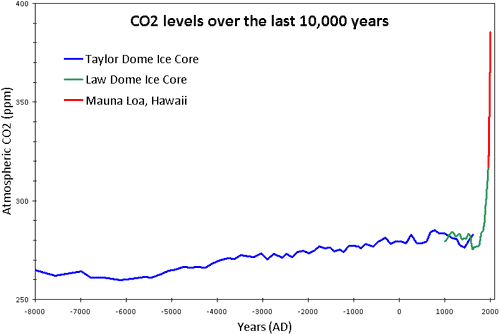
The following graph shows atmospheric CO2 levels over the last 10,000 years. It includes ice core data for CO2 levels before 1950. For values after 1950, direct measurements from Mauna Loa, Hawaii were used.
Figure 1: CO2 levels (parts per million) over the past 10,000 years. Blue line from Taylor Dome ice cores (NOAA). Green line from Law Dome ice core (CDIAC). Red line from direct measurements at Mauna Loa, Hawaii (NOAA).Mauna Loa is often used as an example of rising carbon dioxide levels because its the longest, continuous series of directly measured atmospheric CO2. The reason why it’s acceptable to use Mauna Loa as a proxy for global CO2 levels is because CO2 mixes well throughout the atmosphere. Consequently, the trend in Mauna Loa CO2 (1.64 ppm per year) is statistically indistinguishable from the trend in global CO2 levels (1.66 ppm per year). If global CO2 was used in Figure 1 above, the result “hockey stick” shape would be identical.
Judith Curry may be a good source for ongoing coverage of climate change technical details.
And in the communications department, Treehugger blogger Margaret Badore runs down the story on a professor and a student who take the data … and make music out of it. It’s quite moving, and worth your time.
(h/t CNN)
Jeb Bush gets on the right page – Steve Benen of MaddowBlog reports how Republicans never make a mistake:
Former Florida governor Jeb Bush would have authorized the 2003 invasion of Iraq, as his brother and then-president George W. Bush did, he told Fox News’ Megyn Kelly in an interview to be aired Monday. …
Note the evolution in Jeb Bush’s approach to the issue. Just three months ago, asked about the disastrous war in Iraq, the Florida Republican told reporters, “I won’t talk about the past…. If I’m in the process of considering the possibility of running, it’s not about re-litigating anything in the past.” Soon after, Jeb Bush was willing to concede “mistakes were made,” but he wouldn’t say who made the mistakes or how he would have done anything different.
Jon Green at AMERICA blog thinks Jeb is doing the right thing:
But here’s the thing: despite the baggage George W. Bush would bring as a surrogate, Jeb probably loses less by embracing his record than he gains by distancing himself from it. No matter what he says about the previous Bush administration, he’s going to be tied to it. If he runs from it, it’ll be seen as a political dodge. Owning the issue tells voters that he doesn’t think it’s a liability, so they shouldn’t, either. Given that Hillary’s position on the Iraq War is, for all intents and purposes, the same as Jeb’s — “We made the best decision we could given the information we had.” — Jeb does more to defuse Iraq as a 2016 campaign issue by embracing the invasion than he does by criticizing it. As there is no clear separation between any of the 2016 frontrunners on the issue, none of them feel any particular need to play defense on it.
This may be true for the Republican base, to which he is initially playing, but Independents, who he would have to win over for the general election, should have more critical faculties and be willing to say, If he doesn’t seem Iraq as a critical mistake, even a lie as Andrew Sullivan eventually decided, then why should we cast a vote for him?
This is, at best, a roll of the die.
Bernie Sanders campaign fires off an early shot:
“Never again should a financial institution be able to demand a federal bailout,” Sherman said. “They claim; ‘If we go down, the economy is going down with us,’ but by breaking up these institutions long before they face a crisis, we ensure a healthy financial system where medium-sized institutions can compete in the free market.”
The 2008 financial crisis had a devastating impact on the U.S. economy. It cost as much as $14 trillion, the Dallas Federal Reserve calculated. The Government Accountability Office pegged the cost at $13 trillion. The Congressional Budget Office estimated that the crisis nearly doubled the national debt and cost more than the Bush tax cuts and the wars in Iraq and Afghanistan combined.
The six largest U.S. financial institutions today have assets of some $10 trillion, an amount equal to almost 60 percent of gross domestic product. They handle more than two-thirds of all credit card purchases, control nearly 50 percent of all bank deposits, and control over 95 percent of the $240 trillion in derivatives held by commercial banks.
The Sanders and Sherman legislation would give banking regulators 90 days to identify commercial banks, investment banks, hedge funds, insurance companies and other entities whose “failure would have a catastrophic effect on the stability of either the financial system or the United States economy without substantial government assistance.”
While being well aware this will never pass, it’s the sort of thing that makes some sense and part of me very much wants to see it pass just to see “what if“?
Sanders further comments on the HuffPo Politics blog:
It should make every American very nervous that in this weak regulatory environment, the financial supervisors in this country and around the world are still able to uncover an enormous amount of fraud on Wall Street to this day. I fear very much that the financial system is even more fragile than many people may perceive. This huge issue cannot be swept under the rug. It has got to be addressed.
Although I voted for Dodd-Frank, I did so knowing it was a modest piece of legislation. Dodd-Frank did not end much of the casino-style gambling on Wall Street. In fact, much of this reckless activity is still going on today.
The Hill can’t resist comparing Sanders to Senator Elizabeth Warren, who is not running:
The overlap between Sanders’s message and the one frequently espoused by Warren was indistinguishable at one point.
“The function of banking should be boring,” said Sanders on Wednesday.
Warren has frequently sung from the “banking should be boring” hymnal, doing so most recently in a speech in April.
“If banks want access to government-provided deposit insurance, they should be limited to boring banking,” she said.
When Sanders launched his presidential campaign earlier this month, he earned plaudits from liberal grassroots groups for his long record on fighting inequality and battling the nation’s most powerful. Many of those same groups also said they were still waiting for Warren to jump into the race.
George Zornick at The Nation sees Sanders as creating a litmus test for Presidential candidate Hillary Clinton, as well as currently sitting legislators:
The prospects of this bill passing in a Republican-controlled Congress approach absolute zero. Sanders acknowledged that reality, but said the legislation presents a basic test for legislators.
“When Wall Street tells members of the Congress not to do anything that will damage their interests, most members of Congress adhere to that,” he said. “Can we pass legislation in the United States Congress that Wall Street opposes?”
It also unavoidably poses a test for Hillary Clinton, the other declared Democratic candidate. Much of the Draft Warren movement launched by progressive activists focused on the Massachusetts senator’s advocacy for combating the financial sector’s power generally, and breaking up the big banks in particular—and Clinton’s perceived weakness on that front.
George also notes that potential candidate and former Governor O’Malley recently wrote an op-ed of a similar nature. I think this strategy is good – get uncomfortable questions out there about an industry which can hardly be said to be a free market, given how many of these huge banks benefited from bargain prices on their road-kill prey.
Community bankers are hip to it:
That sounds like a good idea to the Independent Community Bankers of America, a trade association representing more than 6,000 banks across the country.
“ICBA agrees that the too-big-to-fail megabanks are too big to exist,” said ICBA President and CEO Camden Fine. “After triggering a historic financial crisis and receiving trillions of dollars in taxpayer assistance, the nation’s largest and riskiest financial institutions continue to pose systemic threats to our economy while enjoying an artificial funding advantage subsidized by taxpayers.”
The left is on the march, and the billionaires and corporations are in for a fight.
Another missive from the same correspondent on this long running subject :
Yes, we do spend too much on end of life care, very often to the detriment and discomfort of the patient! Some of that is driven by the system about which I complain — more profits are to be had by all that excessive treatment, and it also does a better job of avoiding law suits over not doing enough. (Clearly the American public is at fault here, too, for their warped expectations, but I’d also argue that some of those expectations were created by profit-minded health care marketing.)
I would prefer to think the American public are adults, although given how we abuse ourselves I might be hard-pressed to defend the assertion. Nevertheless, brain-washing charges are difficult to uphold on the large scale implied here, and I should like to think it’s less Big Pharma and more simply our national culture to fight for everything we can.
I didn’t delve into this issue, but I am well aware of it. I only used a broadside against Big Pharma because they are so plainly wrong and greedy. But yes, there are plenty of drivers to our high costs. Big Pharma and excessive end of life care are definitely 2 of the largest ones. I’m really busy these days, but maybe if I get motivated I’ll try to look up some of my sources (e.g. articles written by doctors themselves in The Atlantic, etc.). I can’t promise anything. Oh, and how are my bonafides not applicable? The point is, I’m far better informed on the subject than the vast majority of the population, both from job experience and personal research and interest in the subject.
Working in a highly technical position within an industry doesn’t make one an expert on the moral issues of that industry – it can give one special access, but not everyone takes advantage of it. That’s why I didn’t really care about those particular bona-fides – I worked in one of the earliest HSM shops, but today I don’t have an opinion on HSMs; I don’t even know if they’re still in use.
But participating in round tables with experts … that’s interesting. So long as the experts don’t turn out to be Dick Morris.
This lovely letter from Liz Bell shows up in NewScientist (25 April 2015) (paywall):
It also strikes me that the enormous diversity of belief is a source of strength for our species, giving us flexibility, adaptability and options in coping with new challenges. The harm wreaked by fundamentalists and extremists is that they try to remove this diversity and impose uniformity, through moral imperatives, group interest and threatening violence towards dissidents.
I like to believe that by doing so they sow the seeds of the eventual destruction of the systems and societies they are trying to create, as they become unable to deal with new challenges that conflict with their rigid beliefs.
I think that’s absolutely lovely and applies to many things where people don’t see how diversity applies – for example, marriage.
The marijuana movement recently acquired a slightly different ally:
Republican state Rep. David Simpson of Longview argues marijuana comes from God and therefore shouldn’t be banned by government. The tea party stalwart has repeatedly championed what he calls the “Christian case” for legalization.
Jacob Sullum, REASON.com senior editor, takes note of the Marijuana Policy Project in Texas:
“I know that if we win there, we win the country,” [Rob Kampia, executive director of the Marijuana Policy Project] says. “I know decrim has a chance in Texas already, and I know that while people like to think of Texas as very conservative, the people of Texas are not as conservative as people outside of Texas think, that Texas is going to turn from a Republican state to a Democratic state at some point in the next eight years. So I said we can give that a whirl….We hired a lobbyist, have a full-time staffer in Austin who’s coordinating the grassroots, and now we’re seeing real momentum in the legislature as a result of the focused effort.”
Here is Mr. Simpson’s web site:
I covet your prayers now as we prepare …
That’s an interesting turn of phrase. Here he gives his views on the subject:
As a Christian, I recognize the innate goodness of everything God made and humanity’s charge to be stewards of the same.
In fact, it’s for this reason that I’m especially cautious when it comes to laws banning plants. I don’t believe that when God made marijuana he made a mistake that government needs to fix.
Good is contextual; I recall how my GP nearly broke down and cried when he admitted his own son had said, “But Dad, it’s natural, it’s gotta be good for you.” Even for bees, plant nectar can be poisonous – or not, depending on just what sort of bee you may be.
So, to Representative Simpson, we’d have to ask how arsenic is good for you, or any of a host of substances.
He may have reached what I regard to be probably a right conclusion, but the path seems dubious at best.